


Overview
When Danish Iqbal founded Medusa Distribution wholesale vape and smoke shop in March 2015, he operated out of half a rented room used for fulfilling products. Success was his vision, and it was non-negotiable. After a decade on Wall Street at various hedge funds, he wanted to build something tangible where thriving would be directly tied to his own efforts.
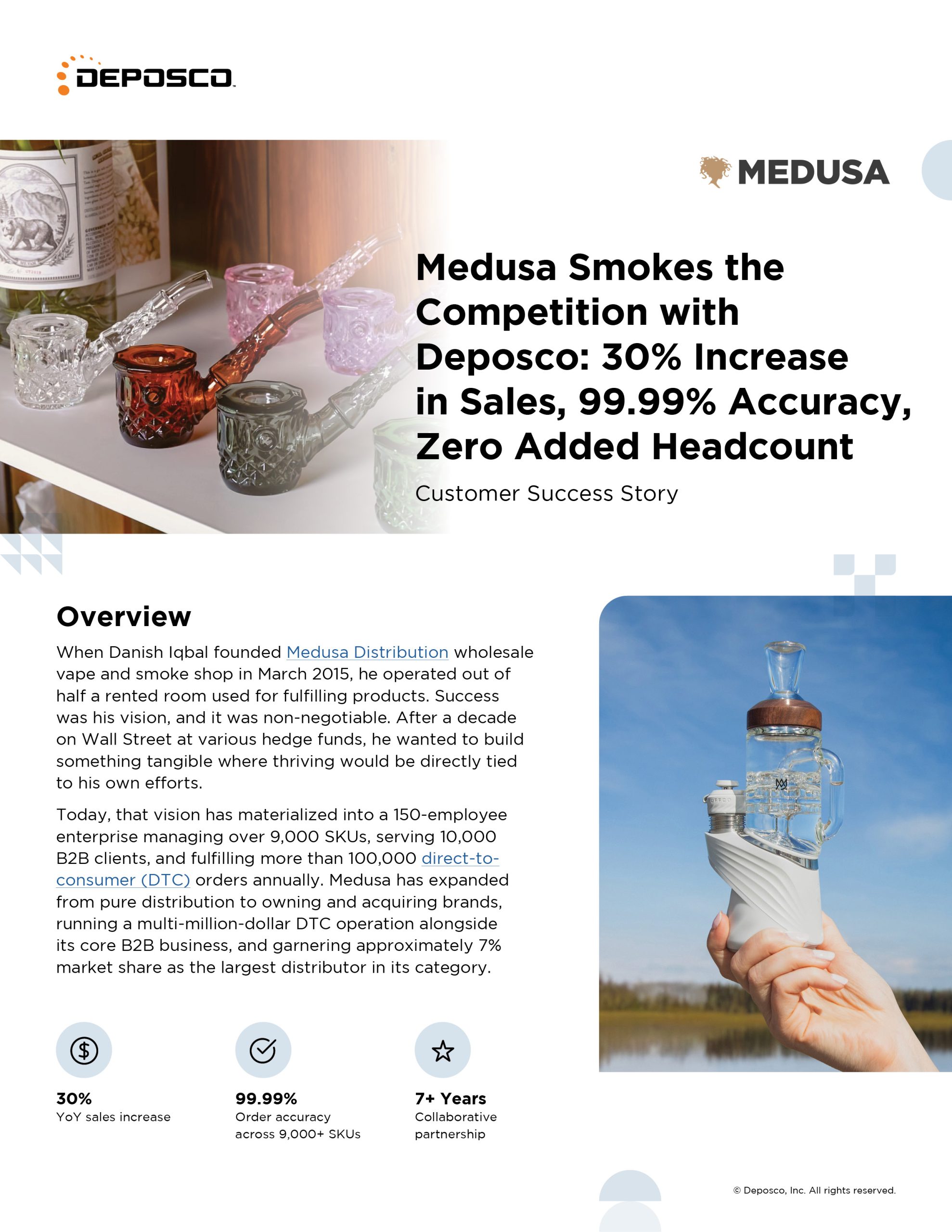
Today, that vision has materialized into a 150-employee enterprise managing over 9,000 SKUs, serving 10,000 B2B clients, and fulfilling more than 100,000 direct-toconsumer (DTC) orders annually. Medusa has expanded from pure distribution to owning and acquiring brands, running a multi-million-dollar DTC operation alongside its core B2B business, and garnering approximately 7% market share as the largest distributor in its category.
Medusa’s early growth strategy was simple: outwork everyone. Answer every call, ship every order in under two minutes, and build a reputation for speed that attracts customers, but it happened faster than their operations could handle. Medusa was running on an ERP connected via Zapier integration to a warehouse printer—no location-based inventory, no systematic processes.
Warehouse workers were physically shuffling paper pick tickets based on what was easiest, while customers who had ordered days earlier waited. The stress stemmed simply from the fact that no one knew where anything was. The combination of inadequate space and missing systems created chaos.
Iqbal describes it as a “leaky bucket” problem: new customers were flowing in at the top, but longtime B2B clients—some who had been with Medusa since before they could accept credit cards—were leaking out the bottom. The breaking point came when he realized the people who had known Medusa longest were the ones leaving.
We went live on Labor Day, moved on Black Friday, and then COVID started in March. Our sales went up 26-30%, and we didn’t add a single head. That’s when you started to see the real impact—batch picking, knowing where stuff was, knowing your inventory was accurate.”
Solution
Andrew Haner, now Chief Operating Officer, joined Medusa as a consultant in 2018. Introduced to Iqbal through mutual contacts in the corrugated packaging business, he arrived with experience from The Home Depot, Tiffany, and other sophisticated operations, bringing kitchen timers to measure every atomic step in Medusa’s warehouse processes. His proposal was direct: he would allocate his salary to operational improvements in the first year. This included selecting and implementing a warehouse management system that could serve today’s challenges and scale with Medusa’s growth trajectory.
We had to tell customers to stop buying from us until we could fix our operations. When your longest-tenured customers start abandoning you, that tells you everything you need to know. I focused the entire company’s efforts on figuring out how to make that better.”
In their talks, they landed on Deposco as the clear choice for several reasons: cloud-based architecture (while competitors were still proposing on-premise servers), pre-built integration with Medusa’s existing ERP (TradeGecko), and comprehensive APIs that would allow its internal development team to build custom extensions.
The implementation moved fast—PO signed in 2018, go-live on Labor Day, and a facility move on Black Friday. Rather than customizing the platform to match existing processes (which didn’t exist), Medusa adopted Deposco’s standard workflows for wholesale receiving, picking, packing, and built from there.
Today, Deposco serves as the core of an integrated technology ecosystem with Lucas Systems for voice-directed picking, with 80% of orders now picked on voice headsets. They’ve implemented AI-powered cartonization that recommends optimal box sizes for each order. Conveyance systems connect the picking stations to the packing stations. The Deposco platform’s API architecture has enabled Medusa’s internal development team to easily stand up and maintain custom integrations.
When Deposco showed up talking about cloud-based systems, a bunch of software vendors were pitching us servers in a closet. Even in 2018, I’m like—that seems really dumb.”
When the pandemic hit in March 2020, just months after moving into a new facility in Thanksgiving 2019, most distributors scrambled. Medusa scaled. The company achieved a 30% increase in sales without adding a single additional staff member, demonstrating the operational leverage its investment in Deposco had created.
The transformation went beyond efficiency metrics. Order accuracy now exceeds 99.99%. Iqbal says the “temperature” in the warehouse dropped dramatically after Deposco, the stress replaced by systematic, predictable operations. Inventory accuracy, which had previously relied on theoretical calculations (what we bought minus what we shipped), became verifiable
That operational foundation has enabled explosive recent growth. In Q4 of 2025 versus the prior year, Medusa’s DTC orders grew 500- 600%, with one owned brand generating 50% of its entire 18-month lifetime revenue in just the final two months of the year. That’s a kind of growth that no model could have predicted, absorbed without a platform change.
For 5x-6x growth in numerical terms, and for you to not have to do anything with the software managing it—that’s the definition of success.”
The tech-enabled facility itself has become a sales tool. When brand CEOs visit Medusa’s New Jersey warehouse—where voice headsets communicate in real time, AI recommends pack materials, and a clean facility with visible precision—they gain confidence that translates into exclusive distribution partnerships. Medusa’s strategy mirrors Target’s private-label approach: stock the major brands that draw customers, then offer house brands alongside them. A professionally operated warehouse and supply chain platform makes that pitch credible.
The ROI logic for B2B is straightforward: faster delivery every day means one day earlier to revenue. Unlike DTC, where a Thursday versus Friday delivery rarely affects reorder rates, B2B customers can sell a product one day earlier if it arrives one day sooner. At Medusa’s scale across thousands of customers, that speed translates to millions in accelerated cash flow.
But Iqbal frames the value in simpler terms: Deposco is the part of the stack he doesn’t have to think about. When giving facility tours, he tells visitors that everything they don’t have to think about regularly is the stuff that’s going well.
I’ve never delayed a change to our business because the fulfillment platform won’t be able to handle it. We have enough confidence where we just do what we need to do—and the Deposco piece lets us figure it out.”
Seven years in, Medusa has referred multiple companies to Deposco. When asked what would cause them to consider a change, Iqbal’s answer reflects his philosophy: a supply chain platform is like a marriage. You evaluate people’s character, not just the technology. Nothing short of a fundamental change to Deposco’s identity would prompt him to look elsewhere.