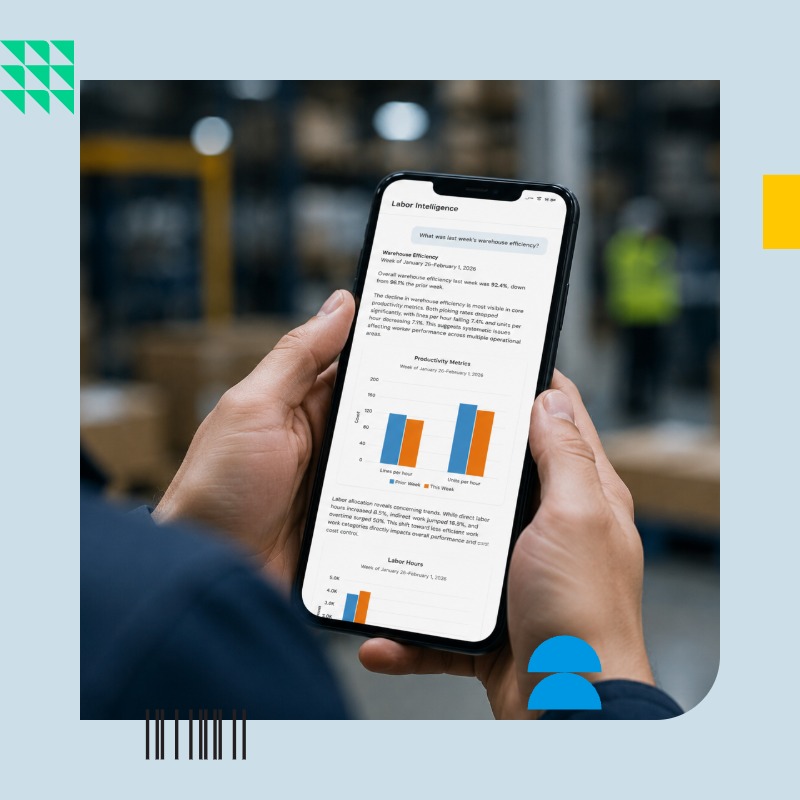
The operations director at a mid-size fulfillment operation noticed something in her weekly numbers. Labor cost per order was up about 11% compared to the same period last month. Volume was flat. Headcount hadn’t changed. She pulled her usual reports and couldn’t find the source.
She asked Felix.
“What’s driving the increase in labor cost per order over the last 30 days?”
Felix came back in seconds. Multiline, multi-quantity orders. Throughput on that order type had dropped 23% over the past three weeks. One specific worker — one of the more experienced pickers on the floor — accounted for a disproportionate share of the decline. And there was something else: wait time for orders to move from pick completion to pack station had increased from 1.4 hours to 1.75 hours. That gap was showing up as idle time on packers who were ready to work but waiting on picked inventory.
She hadn’t known any of that before she asked the question. She would have found some of it eventually. Felix found all of it in the time it took to type a sentence.
How Felix Actually Works
Felix is Deposco’s AI assistant — but calling it a chatbot undersells what it does. Felix is a knowledge graph that connects labor data, order data, worker performance data, process data, and platform benchmarks into a single model. When you ask Felix a question, it’s not searching a database and returning a result. It’s reasoning across all of that connected data to give you a specific, contextual answer.
The other layer is what Deposco calls causal AI — a proprietary model that maps known relationships between operational inputs and outcomes. Shipping costs go up because of priority shipping or longer zones. Packer idle time increases because pick-to-pack gap widened. These are known relationships. Felix uses them to move from observation to root cause rather than stopping at the symptom.
That’s the difference between a diagnostic that says “throughput is down” and one that says “throughput is down on multiline orders, the likely cause is pick-to-pack gap time, the worker most affected is X, and the gap has been widening for 18 days.”
Two Paths to the Same Insight
Labor Intelligence gives you two ways to get to what you need.
The first is the analytical path. You pull the performance page, filter by order type, look at throughput trends, drill into individual workers, and trace the problem yourself. That’s the path for industrial engineers and operations analysts who want to own the investigation.
The second is Felix. You ask in plain language. Felix does the analysis and gives you the answer — same underlying data, same benchmarks, same causal connections, delivered without requiring you to know which charts to pull. Both paths reach the same place. Some people want to navigate. Others want the destination. Felix makes sure both are available.
What the Operations Director Did Next
She went to the floor and talked to the worker Felix had flagged. He’d been dealing with a handheld that was intermittently losing connectivity. He hadn’t reported it because he assumed it was a known issue. It wasn’t.
The equipment got swapped out that afternoon. The pick-to-pack gap got addressed by adjusting the staffing ratio between picking and packing on the afternoon shift. Within a week, multiline throughput was back to its prior level and labor cost per order had normalized.
None of that would have happened as quickly without the data. And the data wouldn’t have surfaced as quickly without Felix. That’s what AI-powered labor management looks like in practice: not a dashboard you check occasionally, but a system that finds the problem, explains it, and points you toward the fix.
The operations director couldn’t find the source in her usual reports. She asked Felix one question and got the order type, the worker, the pick-to-pack gap, and the 18-day trend — in the time it took to type a sentence. That’s the difference between a dashboard you check and a system that finds the problem, explains it, and points you to the fix.