
The best 3PL WMS for ecommerce fulfillment in 2026 is the one that holds accuracy when a client’s promotion triples order volume overnight. Deposco leads for mid-market 3PLs serving DTC and marketplace brands, with ShipHero, Logiwa, Extensiv, and Da Vinci Unified fitting narrower profiles. This guide compares all five on the four things ecommerce clients measure a 3PL on: peak accuracy, channel connectivity, shipping cost, and order routing across locations.
What ecommerce brands expect from their 3PL’s system
A DTC brand that outsources fulfillment is outsourcing its customer experience. The brand’s shoppers do not know the 3PL exists; they know whether the order arrived complete and on time. That puts the 3PL’s warehouse system directly on the brand’s retention line.
When 3PL leaders serving ecommerce clients evaluate a WMS, the problems they are trying to solve look like this:
- Order accuracy holds at 99% in March and slips in November, and the November number is the one the client remembers at renewal.
- Every new brand arrives on a different mix of carts and marketplaces, and each connector is a small integration project.
- Shipping costs are quoted to the client at contract signing and eaten by the 3PL when the carrier mix is wrong.
- Brands with inventory in more than one node expect orders routed to the cheapest, fastest location automatically.
In this guide, we evaluated five 3PL warehouse management systems built for that environment:
- Deposco (Best for mid-market 3PLs running DTC and marketplace fulfillment at peak scale)
- ShipHero
- Logiwa
- Extensiv
- Da Vinci Unified
How we evaluated ecommerce fulfillment WMS platforms
Each platform was assessed on four dimensions specific to ecommerce 3PL work:
- Peak accuracy and throughput. Does order accuracy and system performance hold when a client’s volume spikes?
- Channel connectivity. How many carts, marketplaces, and carriers connect without custom development?
- Shipping cost control. Is rate shopping native, and does it run at the order level?
- Multi-node order routing. Can orders route across warehouses by cost, speed, and inventory position?
Evaluations reflect publicly available vendor documentation, customer references, and Deposco’s implementation experience with ecommerce 3PLs as of August 2026. No vendor paid for placement. Conduct independent evaluation and proof-of-concept testing before selecting a platform.
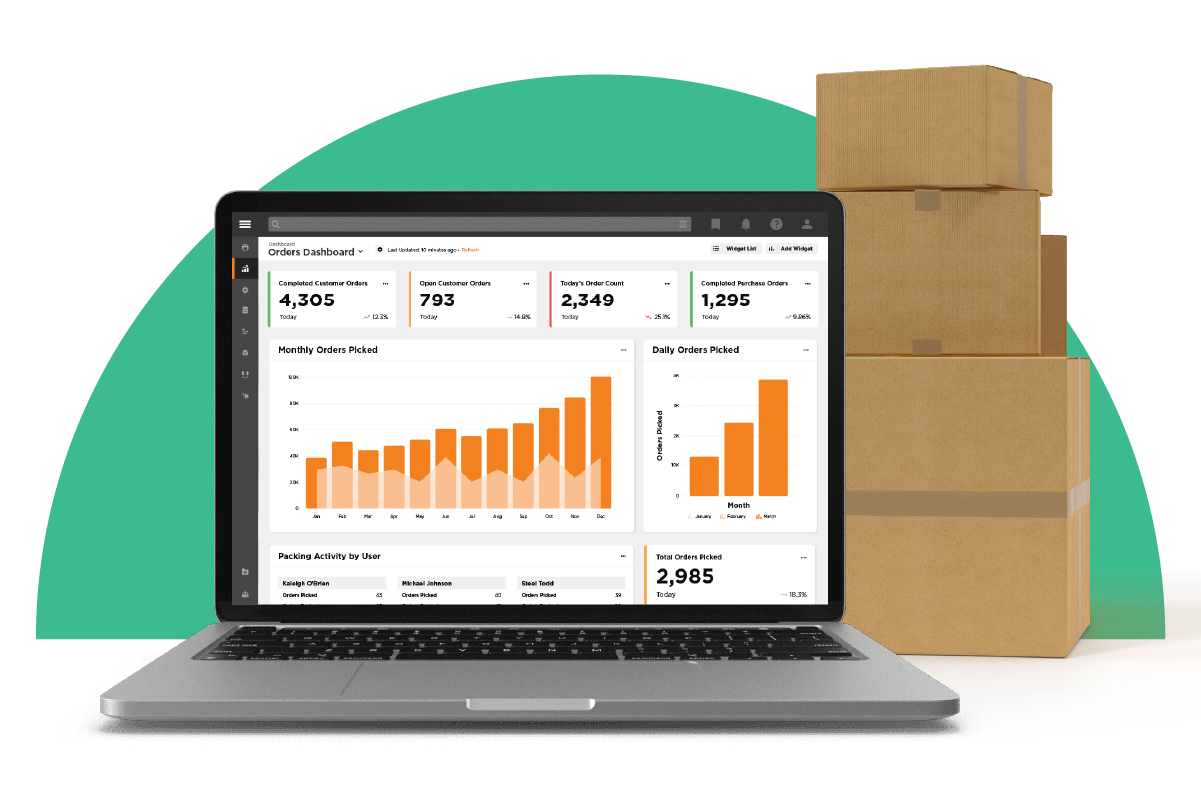
1. Deposco
Best for: mid-market 3PLs whose ecommerce clients bring marketplace complexity, seasonal spikes, and multi-node inventory, and who need all of it on one system.
Deposco combines warehouse management, distributed order management, shipping, and 3PL billing on one cloud-native platform, with more than 150 pre-built integrations to the carts, marketplaces, and carriers ecommerce brands run on. On the brand side, Plant Therapy tripled productivity and cut fulfillment to under 24 hours on Deposco; on the 3PL side, ITB Fulfillment scaled 9x in year one with 100% uptime and an error rate under 1%.
Accuracy that holds at peak
Gap: Many ecommerce WMS platforms are tuned for the average day. When a client’s launch or promotion multiplies volume, pick paths degrade, exceptions pile up, and the accuracy rate the 3PL sold on becomes the number it apologizes for.
How: Deposco directs picking, packing, and verification through scan-validated workflows that do not change when volume does, and the cloud-native architecture scales with the order queue rather than against it. ITB Fulfillment grew order volume 9x in its first year with 100% uptime and an error rate under 1%.
Scenario: A beauty brand client runs a flash sale that pushes 11,000 orders into the queue in four hours. The 3PL’s floor supervisor does not reconfigure anything. Pick waves build on cut-off time and carrier, packers scan every unit against the order, and the accuracy report the next morning reads the same as it did the week before.
Every channel connected on day one
Gap: Each new ecommerce client shows up on a different stack: Shopify plus Amazon plus a wholesale EDI trading partner. When each connector is a project, onboarding stalls and the client’s first impression is a delay.
How: Deposco’s integration library includes pre-built connectors for Shopify, Amazon Seller Central, WooCommerce, Magento, SPS Commerce, ShipStation, and the major carriers, switched on per client rather than built per client. Derby Supply Chain Solutions has onboarded clients in as little as two hours.
Scenario: A VP of Operations signs an apparel brand selling on Shopify, Amazon, and TikTok Shop with a Nordstrom wholesale program on EDI. The connectors are enabled from the library, the EDI partner profile is setup seamlessly, and orders from all four channels are flowing before the brand’s inbound freight arrives.
Rate shopping at the order level
Gap: Shipping is the largest cost line in DTC fulfillment and the one most 3PLs quote before they know the carrier mix. A WMS that ships on a fixed carrier rule leaves margin on the table every day.
How: Deposco’s shipping and parcel management rate-shops each order across carriers and service levels against the client’s delivery promise. The approach is detailed in Deposco’s guide to 3PL rate shopping for DTC clients.
Scenario: A 3PL’s finance lead notices that one client’s shipping cost per order is running above the contracted rate. With order-level rate shopping switched on, the system starts routing lightweight orders to a regional carrier that meets the two-day promise, and the per-order cost drops below contract within the first billing period.
Orders routed across nodes automatically
Gap: Brands that split inventory across two or three 3PL locations expect orders to route to the node that ships cheapest and fastest. Without distributed order management, the 3PL routes by hand or by a static rule that ignores inventory position.
How: Deposco’s distributed order management routes each order by inventory availability, proximity, cost, and service level across every location the client uses. The mechanics are covered in Deposco’s guide to multi-location fulfillment for 3PLs.
Scenario: A supplements brand stocks its top 50 SKUs in the 3PL’s Reno and Pennsylvania buildings. An order from Phoenix routes to Reno; an order from Boston routes to Pennsylvania; an order for a SKU that Reno is out of routes east without anyone touching it. Transit days fall and the client stops asking why West Coast orders shipped from the East.
Considerations: 3PLs whose ecommerce clients sell primarily outside North America should confirm regional carrier coverage and hosting during evaluation.
Walk through client onboarding, billable activity capture, and Bright Portal with a 3PL systems expert. Built for the midmarket operator adding clients faster than headcount.
2. ShipHero
ShipHero markets a cloud warehouse management system built around DTC order flow, sold both to ecommerce brands running their own warehouses and to 3PLs serving them. Its public positioning focuses on picking and packing speed and native shipping.
- Mobile app for picking, packing, and receiving on handheld devices
- Pre-built connections to Shopify, Amazon, and other DTC sales channels
- Shipping with carrier rate selection built into the pack workflow
- Client-facing portal for order and inventory visibility
3. Logiwa
Logiwa markets Logiwa IO as a fulfillment management system for high-volume DTC brands and 3PLs, positioned on configurability and AI-assisted task generation. Its public materials describe an API-first architecture and an app store for integrations.
- Drag-and-drop workflow configuration without code
- AI-assisted job creation that assigns warehouse tasks from order flow
- Marketplace, cart, and carrier integrations through an app store
- Client-specific portals and billing for multi-client operations
4. Extensiv
Extensiv markets a suite for SMB and lower mid-market 3PLs that combines 3PL Warehouse Manager, an order management product, an integration layer, and network tools for multi-warehouse operators. Its ecommerce positioning rests on the breadth of its connector catalog.
- Cart and marketplace connectors through the integration layer formerly sold as CartRover
- SmartScan mobile scanning for pick, pack, and receive
- Network Manager for multi-warehouse and 4PL setups
- Billing Manager for activity-based invoicing
5. Da Vinci Unified
Da Vinci Unified markets a cloud WMS for 3PLs and brands with multi-client operations, billing, and ecommerce integrations. Its public positioning targets small to mid-size operators that want one system for warehouse execution and client management.
- Multi-client inventory and order management
- Ecommerce cart and marketplace integrations
- 3PL billing and client reporting
- Multi-warehouse support with rate shopping
How Deposco can help
Every platform here can process an ecommerce order. What separates them is what happens on the day a client’s volume triples, a new brand arrives on four channels, or a carrier contract changes mid-season.
If you run the floor: Deposco’s scan-validated workflows keep accuracy flat through peak. ITB Fulfillment held 100% uptime and under 1% errors while scaling 9x.
If you own client onboarding: 150+ connectors mean the brand’s channel stack is a checklist, not a project. Derby has onboarded clients in as little as two hours.
If you own the margin: order-level rate shopping and distributed order management attack the two largest cost lines in DTC fulfillment: postage and transit.
Ecommerce growth does not arrive evenly. It arrives in launches, drops, and holiday weeks that test whether the system underneath the 3PL was built for the spike or for the average. Measure your last peak on accuracy, connector lead time, and cost per order, then see what a platform built for the spike looks like in production.
ITB Fulfillment grew 9x in year one. Derby onboards new clients in 2 hours. Nimbl cut four days from month-end close. Schedule a live demo with a 3PL systems expert.
Evaluation Disclaimer
The evaluations, comparisons, and recommendations in this article represent opinions based on limited publicly available information, selected customer reviews, analyst reports, and industry publications as of July 2025. These assessments do not constitute comprehensive evaluations of all available WMS solutions or reflect the complete range of user experiences across different implementations.