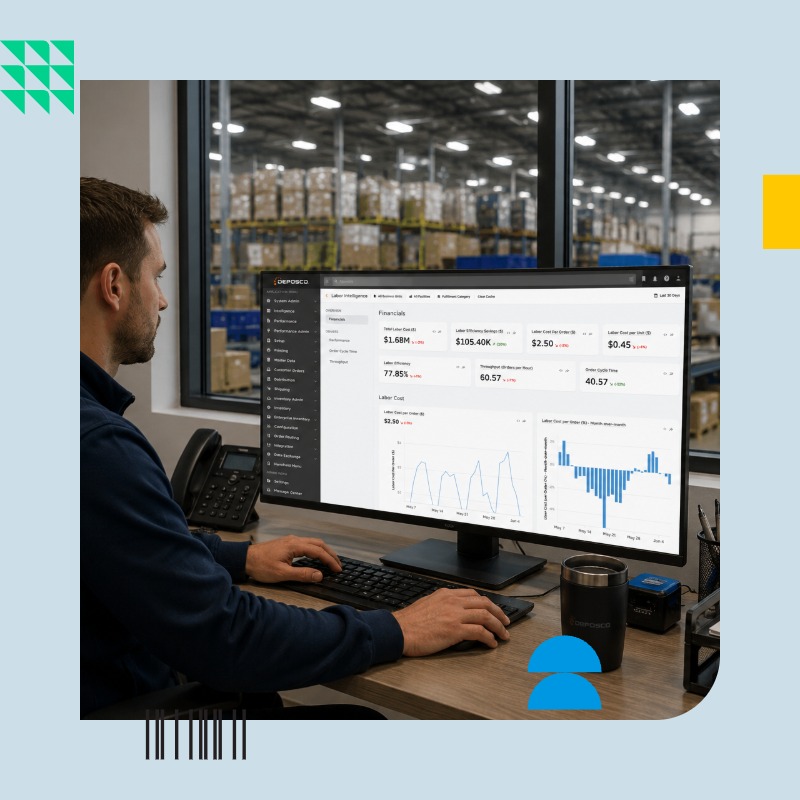
Sixty million labor hours is a lot of data to sit on.
That number comes from scan events across the Deposco platform: 5,500+ brands, 60,000+ warehouse workers, $70 billion in gross merchandise value processed. Not survey data. Not industry estimates. Actual scan-level records from real warehouses running real operations.
When you have that much data, patterns emerge that no single operation could ever see from the inside. A few of them surprised us.
Order complexity is the biggest efficiency killer
The gap between single-line, single-unit orders and multiline, multi-quantity orders is large, and most operators underestimate it. A warehouse running efficiently on simple orders can look healthy in aggregate, even when its complex order throughput is well below the platform median.
Multiline, multi-quantity orders take longer to pick, longer to pack, and generate more process variation. Most operations manage them with the same labor expectations as simpler orders, because without order-type-level visibility, the difference is invisible.
Felix surfaces this automatically. Instead of waiting for an analyst to pull a report, Felix flags when complex order throughput is diverging from the platform median and quantifies the gap in dollars. Finding that on Tuesday morning instead of in a quarterly review is a materially different outcome.
Utilization gaps are usually bigger than efficiency gaps
Most operators track efficiency: how fast workers process orders when they’re active. The data says they should pay equal attention to utilization: what percentage of shift time workers are actually working.
The gap between clocked-in time and active scan time is where labor cost quietly disappears. Some of it is planned: breaks, transitions, equipment changeover. A lot of it isn’t. Post-break reactivation. Waiting for work. System login delays.
A warehouse at 85% efficiency but 65% utilization is leaving more money on the floor than one at 75% efficiency and 80% utilization. Most operations focus on the first number. Labor Intelligence tracks both and connects them so you understand not just what the numbers are but what’s driving them.
Pick method matters more than most operators realize
Platform data shows significant throughput differences between pick methods for the same order types. Batch picking with queue packing can hit rates more than 4x higher than single-scan picking for multiline, multi-quantity orders.
The harder insight: you can’t know what high performers are doing differently unless you can see across operations. Labor Intelligence shows you not just how you compare to the benchmark, but which pick methods high-performing operations are using for your exact order types. That’s not a report you build. It’s a question you ask Felix.
Monday and Saturday are your hardest days
Across the platform, efficiency consistently dips at the start and end of the work week. Monday lags Thursday and Friday by a measurable margin in most operations. Saturday, when many facilities run partial crews or cross-trained workers, shows the steepest drops.
This pattern disappears inside weekly or monthly roll-ups that average it away. Labor Intelligence shows performance at the shift and day level. Felix calls out the pattern before you notice it yourself. Once you see it, it’s manageable. Most operations never do.
The benchmark is a starting point, not a ceiling
The operations sitting at the 90th percentile aren’t outliers. They have visibility. They use AI to surface problems fast. And they act on what they find, consistently, every shift.
The operators who get the most out of platform benchmarks aren’t the ones who read them and file them away. They’re the ones who put a number on the wall and hold every week accountable to it.
The 90th-percentile operations aren’t outliers — they just have visibility and act on it every shift. Labor Intelligence and Felix surface utilization gaps, complex-order drag, and pick-method opportunities across your operation in real time, not in a quarterly review.