For a planning or operations leader at a growing mid-market company, the cost of the wrong supply chain planning software isn’t paid in vendor invoices. It’s paid in stockouts eating revenue, cash stuck in excess inventory, and your planning team still opening a broken spreadsheet every Monday morning.
If NetStock is on your shortlist, you’re likely past the point where spreadsheets and manual reorder points hold up. The next question is whether the platform you pick keeps pace as the business adds DCs, channels, dedicated planners, and the kind of inventory complexity that needs multi-echelon math, not single-node replenishment.
The market has shifted. Multi-echelon optimization, automated model selection, and real-time inventory visibility (capabilities that used to live only inside global enterprises) are now within reach of mid-market businesses. The question isn’t whether to upgrade beyond spreadsheets. It’s which platform fits how your team actually plans as you grow.
Mid-market planning and operations leaders evaluating NetStock alternatives are usually dealing with:
- Forecasts generated in spreadsheets or basic tools often fail to account for seasonality and promotions, instead of software that automatically selects the best model for diverse demand patterns.
- Single-node calculations frequently overlook the flow of goods across a network, which makes multi-echelon optimization essential for balancing stock across all distribution centers and stores.
- When planning is isolated from warehouse execution and financial data, it creates friction, whereas a unified platform ensures your inventory plan aligns with actual shipping costs and activity.
- Forecasting workflows that lack transparency are difficult for planners to trust, so it is important to use a system that provides clear logic and allows for manual override control at any level.
In this post, you’ll find 5 NetStock alternatives to help you choose the best supply chain planning platform for your business:
- Deposco — Best for mid-market companies with dedicated planning teams
- Kinaxis — Best for global enterprise concurrent planning
- EazyStock — Best for SMB inventory optimization layered on an existing ERP
- StockIQ — Best for distributors and manufacturers
- Blue Yonder — Best for large enterprise with complex networks
Ready to see what your forecast and inventory plan looks like on real data?
1. Deposco — Best for mid-market companies with dedicated planning teams
BEST FOR: Mid-market companies ($50M–$500M revenue) with at least one dedicated demand planner, real inventory complexity, and a need for enterprise-grade forecasting without an enterprise-grade implementation.

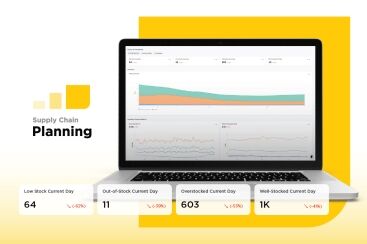
Deposco Supply Chain Planning is built for the gap between Excel and legacy enterprise platforms. It brings together demand forecasting, multi-echelon inventory optimization, and automated purchasing in one system, connecting to a broader Deposco platform that unifies planning (SCP), warehouse execution (WMS), and Supply Chain Intelligence (SCI). For mid-market planners who have outgrown spreadsheets but can’t justify the scope of an enterprise rollout, Deposco Supply Chain Planning was designed specifically for you.
Key feature #1: Automated model selection across 12+ forecasting methods
Gap: Most mid-market planning tools rely on a single forecasting approach or a small handful of statistical methods. SKUs with unusual demand patterns (new product launches, promotional items, seasonal peaks, slow movers) often get planned with the wrong math, and planners end up correcting the model instead of trusting it.
How: Bright Forecast runs 12+ forecasting models including Meta Prophet and Hybrid AI and evaluates which model fits each SKU based on its demand history. Seasonality, trends, and anomalies that break spreadsheets are handled without requiring planners to have deep statistical expertise.

Scenario: A Health & Wellness brand manages 4,000 SKUs across supplements, topicals, and new product launches. Seasonal cold-and-flu items, steady-state daily vitamins, and a new product with six weeks of history all need different forecasting approaches. Bright Forecast assigns the right model per SKU automatically, so the planning team spends its time on exceptions instead of tuning math.
Key feature #2: Multi-echelon inventory optimization across the full network
Gap: Most mid-market planning tools optimize inventory one location at a time. Each DC, warehouse, or store runs its own safety stock math in isolation, which typically means carrying more inventory than the network actually needs.
How: Deposco optimizes inventory across the full supply chain network simultaneously, including DC-to-DC, warehouse-to-store, and DC-to-store flows. Dynamic safety stock recalibrates automatically based on demand variability, supplier lead times, and service level targets, so stock ends up in the right location, not just in the right total quantity.
Scenario: A CPG company with three regional DCs is carrying 20 weeks of supply across the network when 8 would do. Multi-echelon optimization reshuffles stock positions so slow-movers don’t sit in every node and fast-movers are positioned closest to demand.
Key feature #3: Glass Box forecasting transparency with override control
Gap: Many AI-driven planning tools are black boxes. Planners get a number back and no way to see the logic. When their market knowledge tells them the forecast is wrong (a competitor entering the category, a one-time promo, a tariff shift), they can’t adjust it meaningfully.
How: Deposco’s Glass Box approach shows the logic behind every recommendation. Planners can adjust forecasting parameters directly and apply overrides at any level, from an individual SKU to an entire product hierarchy. Market knowledge stays in the plan instead of getting overruled by it.

Scenario: A planner knows a major competitor is entering their category next quarter. Instead of fighting the algorithm, they apply a hierarchy-level demand adjustment on the affected SKUs, and the forecast reflects their insight, with the rationale documented for the next planning cycle.
Key feature #4: Unified platform connecting planning, execution, and Supply Chain Intelligence
Gap: Standalone planning tools require you to bolt together forecasts, purchasing, warehouse operations, and executive reporting across different systems. Data lives in different places, and decisions get made with different numbers.
How: Deposco connects Supply Chain Planning (SCP), Warehouse Management (WMS), and Supply Chain Intelligence (SCI) on one platform. Bright Forecast runs the demand math. Bright Inventory automates time-phased planning and dynamic safety stock. Bright Source handles supplier selection, automatic PO generation, and ASN tracking. SCI Inventory Intelligence puts a dollar figure on inventory decisions and benchmarks performance against anonymous peer data. Executives finally get the report card they’ve been asking for.
Scenario: A CPG brand’s VP of Operations walks into her Monday planning meeting. Her demand planner has been fighting a stockout on a fast-mover; her warehouse manager says receiving just flagged a late PO from a key supplier; her CFO wants to know why inventory turns slipped last quarter. With three separate tools, that meeting becomes three conflicting conversations. On Deposco, all three people are looking at the same data. The planner sees exactly which SKUs are at risk, the warehouse team sees the inbound exceptions that matter, and the CFO sees benchmarked performance against peer companies and where capital is misallocated. One conversation, one set of numbers, one action plan.
2. Kinaxis — Best for global enterprise concurrent planning
Kinaxis is an enterprise concurrent planning platform designed for large global organizations, with a deep deployment footprint in manufacturing, life sciences, and other complex supply chain environments. It serves businesses with mature, centralized supply chain functions.
Features & capabilities
- A concurrent planning architecture that updates demand, supply, inventory, and capacity together rather than in sequence
- What-if scenario modeling for risk, disruption, and capacity-planning workflows
- Multi-tier network modeling across business units, product families, and global geographies
- Enterprise-grade AI assistant capabilities embedded into planning workflows
3. EazyStock — Best for SMB inventory optimization layered on an existing ERP
EazyStock is an inventory optimization platform built to sit on top of an existing ERP. It targets smaller businesses whose ERP lacks native planning capability and need to add demand forecasting and automated replenishment without replacing the underlying system.
Features & capabilities
- ML-driven forecasting that automates reorder points, safety stock levels, and optimal order quantity calculations
- Dynamic ABC classification segmenting inventory by demand type, sales velocity, and demand volatility
- What-if scenario planning that simulates how policy changes affect inventory positions and cash flow
- ERP-layered architecture designed to extend an existing system rather than replace it
4. StockIQ — Best for distributors and manufacturers
StockIQ is a supply chain planning platform aimed at distribution and manufacturing businesses that run a heavy promotional calendar and need sales-inventory-operations alignment. Its emphasis is on event modeling and multi-team planning.
Features & capabilities
- Statistical ensemble forecasting that blends multiple techniques and picks a best-fit model at the SKU level
- Replenishment planning with dynamic safety stock, supplier scorecards, and automated PO recommendations
- Promotion and event modeling that adjusts inventory plans around marketing activity and one-time events
- SIOP module that connects sales forecasts with inventory and operational plans across finance, operations, and supply chain
5. Blue Yonder — Best for large enterprise with complex networks
Blue Yonder is an enterprise supply chain platform spanning planning, execution, and commerce. It’s typically deployed by large retailers, manufacturers, and 3PLs running global operations with the internal resources to maintain an enterprise-scale system.
Features & capabilities
- End-to-end planning suite covering demand, supply, inventory, and S&OP processes
- Integration with execution modules including warehouse management and transportation management
- AI and machine-learning capabilities including a natural language assistant
- Configurability designed for large, complex enterprise environments
Why Deposco stands out among NetStock alternatives for mid-market planning
Each platform on this list has a defensible use case, but they don’t all solve the same problem. EazyStock keeps replenishment simple as an ERP add-on for smaller teams. StockIQ leans into distribution and promotional modeling. Kinaxis and Blue Yonder are built for global enterprise scale and the implementation cycles that come with it.
Where Deposco stands apart for mid-market businesses, particularly the operations and finance leaders who started with NetStock or another SMB tool and outgrew it, is the combination of three things in one platform:
- Enterprise-grade forecasting with 12+ models including Meta Prophet and Hybrid AI, multi-echelon inventory optimization, and Glass Box transparency that lets planners override at any level
- Unified platform architecture connecting Supply Chain Planning, Warehouse Management, and Supply Chain Intelligence so the plan, the execution, and the financial reporting share one set of numbers
- Mid-market fit sized for businesses in the $50M–$500M revenue range, the segment most often stuck between SMB replenishment tools and enterprise platforms, with implementation measured in weeks rather than quarters
If your business has grown past single-node replenishment and you need multi-echelon planning, unified execution, and the kind of forecasting depth that holds up across thousands of SKUs and dozens of demand patterns, Deposco is built for exactly that buyer.
Connect with one of our consultants to see your data live in our platform.
Or if you’d rather start by quantifying the dollar impact of your current inventory plan (stockouts, excess stock, and capital tied up in the wrong SKUs), run an inventory diagnostic on your data with SCI Inventory Intelligence.
Vendor capabilities described in this article reflect publicly available information and vendor documentation as of May 2026. Capabilities, features, and product scope vary by tier, deployment model, and customer size. Confirm current details directly with each vendor. This article is for informational purposes and does not constitute a vendor endorsement.