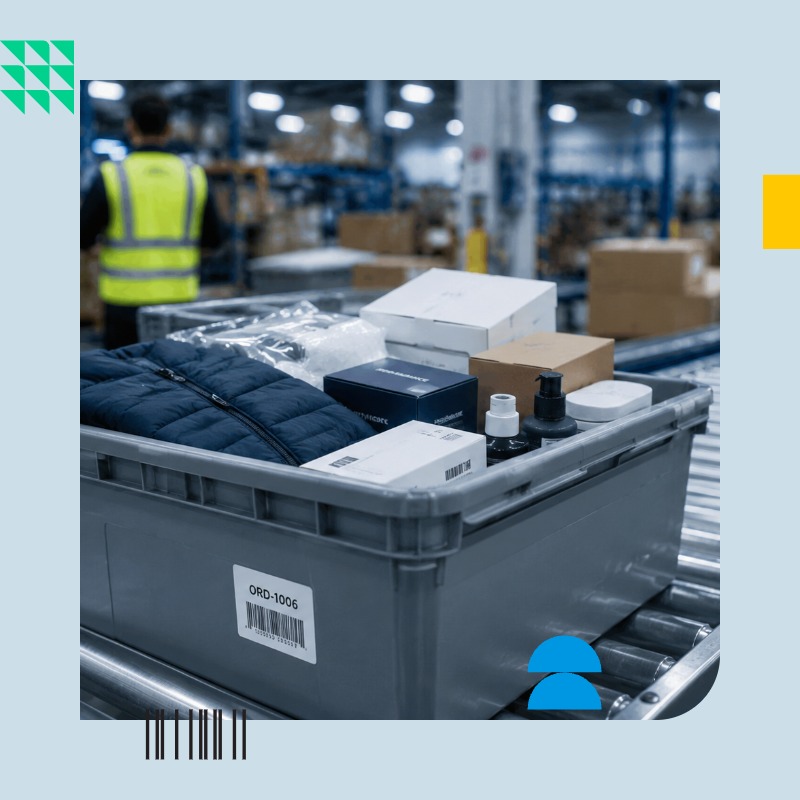
If you want to find where your warehouse is actually losing efficiency, don’t look at your overall numbers. Look at your multiline, multi-quantity orders.
For most operations, that’s where the gap is. Not in single-line picks — those are usually fast, consistent, and easy to staff for. The complexity that breaks throughput, stretches labor cost per order, and creates the most unpredictability lives in the multiline, multi-quantity bucket.
Here’s why, and what to do about it.
Why Complex Orders Are Disproportionately Expensive
A single-line, single-unit order is straightforward. One item, one location, one scan, done. The labor cost is predictable. Staffing for it is straightforward.
A multiline, multi-quantity order is a different animal. Multiple locations. Multiple trips or batch paths. More decisions at the pack station. More potential for error. More handling time per unit. The labor cost per order for a complex order can be 3-5x the labor cost for a simple one — but if you’re not tracking at the order type level, it’s invisible in your aggregate numbers.
That invisibility is expensive. If your cost-per-order calculation blends simple and complex orders together, you’re underpricing the complex ones and subsidizing them with margin from the simple ones.
If your cost-per-order calculation blends simple and complex orders together, you’re underpricing the complex ones and subsidizing them with margin from the simple ones.
The Pick Method Problem
One of the most consistent findings in platform data is that operations using single-scan picking for multiline, multi-quantity orders are leaving significant throughput on the table.
Batch picking with queue packing — where multiple orders are picked simultaneously and sorted at the pack station — can deliver throughput rates more than 4x higher for complex order types. The reason most operations aren’t using it isn’t ignorance. It’s visibility. They don’t know their current throughput rate for complex orders is below the platform median. They don’t know that other operations with similar order mixes are using a different pick flow.
Labor Intelligence surfaces this directly. Felix can tell you which pick methods other high-performing operations on the platform are using for your exact order type — combinations that include at least three other tenants so you’re seeing a real pattern, not a one-off. That’s not a report you build. It’s a question you ask.
What the Data Actually Looks Like
The platform median for single-line, single-quantity orders is around 33 orders per hour. For multiline, multi-quantity, it’s closer to four. That’s not a small gap. Operations using batch picking for their complex orders can push that multiline rate significantly higher — in some cases past 17 orders per hour.
When you can see these numbers broken out by order type and compare them to the platform benchmark, the opportunity becomes specific and actionable. Not “we should improve efficiency” but “our multiline throughput is at 3.89 orders per hour versus a platform median of 4.2, and batch picking with queue packing gets comparable operations to 17+.” Felix produces that analysis on demand. No spreadsheet required.
Where to Start
Break out your labor cost and throughput by order type. If you don’t have that view today, that’s the first fix.
Once you can see the gap, look at your pick flow for complex orders. Is it optimized for the order type, or is it the default method applied to everything? Then ask Felix what other operations are doing for the same order type. The answer might be the most valuable thing you learn this quarter.
If your cost-per-order blends simple and complex orders, you’re underpricing the hard ones and subsidizing them with margin from the easy ones. Labor Intelligence breaks throughput and labor cost out by order type, and Felix tells you which pick methods high-performing operations use for your exact order mix — batch picking with queue packing can move complex-order throughput 4x.