For a mid-market company, the cost of the wrong supply chain planning software isn’t paid in vendor invoices. It’s paid in stockouts eating into revenue, cash stuck in excess inventory, and the planning team still opening a broken spreadsheet every Monday morning.
The planning software market has shifted. Multi-echelon optimization, automated model selection, and real-time inventory visibility (capabilities that used to live only inside global enterprises) are now within reach of businesses in the $50M to $500M revenue range. The question isn’t whether to upgrade. It’s which platform fits how your team actually plans.
When supply chain and finance leaders evaluate SCP platforms, they’re usually dealing with:
- Forecasts built in Excel that can’t absorb seasonality, promotions, or new product launches → software that automates model selection across many demand patterns
- Safety stock set once a year and rarely updated → dynamic policies that recalibrate as lead times and variability shift
- Planning disconnected from warehouse execution and financial reporting → a platform that ties the plan to what actually ships and what it costs
- Planners spending most of their week maintaining spreadsheets → an exception-based workbench that surfaces what needs attention
In this guide, we’ve evaluated 7 of the best supply chain planning software solutions available today, covering features, ideal use cases, and what sets each one apart:
- Deposco — Best for mid-market companies with dedicated planning teams
- NetStock — Best for SMB and lower mid-market replenishment
- Slimstock — Best for retail and promotional planning
- StockIQ — Best for distributors and manufacturers
- EazyStock — Best for SMB inventory optimization layered on an existing ERP
- Kinaxis — Best for global enterprise concurrent planning
- Blue Yonder — Best for large enterprise with complex networks
Our methodology
We evaluated each platform on four criteria that matter most to mid-market planning buyers: forecasting approach, inventory optimization scope (single-node vs. multi-echelon), implementation speed, and integration with adjacent systems like WMS and ERP. Vendor capabilities are based on publicly available information and vendor documentation as of April 2026.
Bring your own data. In several hours hours, see what a Deposco forecast looks like against your real SKUs, your real seasonality, and your real supplier lead times. No slides. No generic demo. Just your forecast, running on 12+ models, with the logic visible end to end.
1. Deposco — Best for mid-market companies with dedicated planning teams
BEST FOR: Mid-market companies ($50M–$500M revenue) with at least one dedicated demand planner, real inventory complexity, and a need for enterprise-grade forecasting without an enterprise-grade implementation.
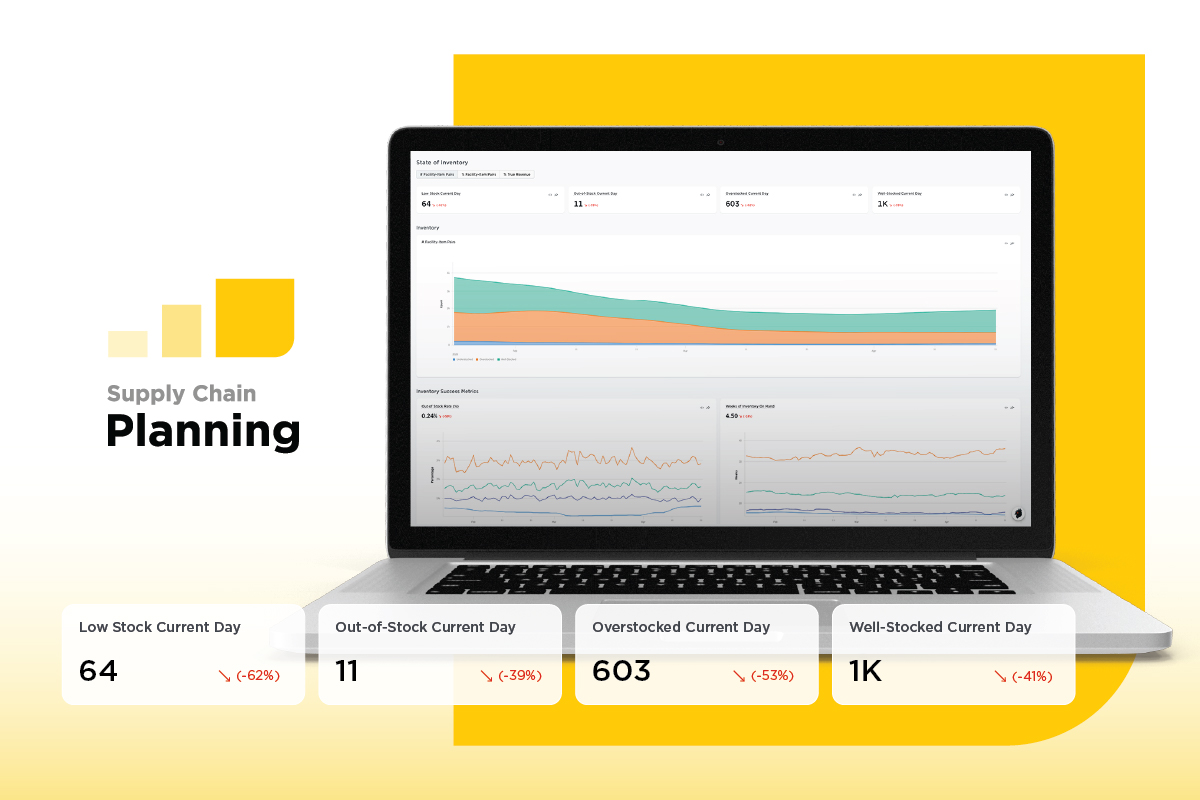
Deposco Supply Chain Planning is built for the gap between Excel and legacy enterprise platforms. It brings together demand forecasting, multi-echelon inventory optimization, and automated purchasing in one system, connecting to a broader Deposco platform that unifies planning (SCP), warehouse execution (WMS), and supply chain intelligence (SCI). For mid-market planners who have outgrown spreadsheets but can’t justify a 12-month enterprise rollout, Deposco Supply Chain Planning was designed specifically for you.
Key feature #1: Automated model selection across 12+ forecasting methods
Gap: Most mid-market planning tools rely on a single forecasting approach or a small handful of statistical methods. SKUs with unusual demand patterns (new product launches, promotional items, seasonal peaks, slow movers) often get planned with the wrong math, and planners end up correcting the model instead of trusting it.
How: Bright Forecast runs 12+ forecasting models (including Meta Prophet and Hybrid AI) and evaluates which model fits each SKU based on its demand history. Seasonality, trends, and anomalies that break spreadsheets are handled without requiring planners to have deep statistical expertise.
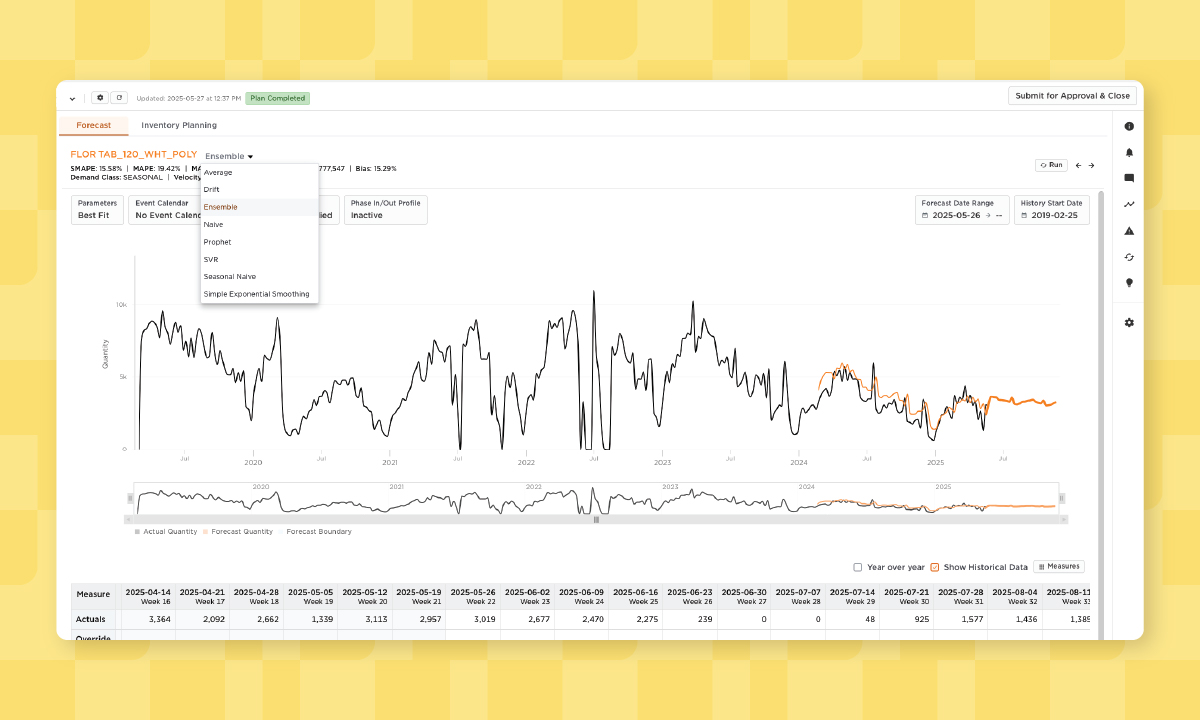
Scenario: A Health & Wellness brand manages 4,000 SKUs across supplements, topicals, and new product launches. Seasonal cold-and-flu items, steady-state daily vitamins, and a new product with six weeks of history all need different forecasting approaches. Bright Forecast assigns the right model per SKU automatically, so the planning team spends its time on exceptions instead of tuning math.
Key feature #2: Multi-echelon inventory optimization across the full network
Gap: Most mid-market planning tools optimize inventory one location at a time. Each DC, warehouse, or store runs its own safety stock math in isolation, which typically means carrying more inventory than the network actually needs.
How: Deposco optimizes inventory across the full supply chain network simultaneously, including DC-to-DC, warehouse-to-store, and DC-to-store flows. Dynamic safety stock recalibrates automatically based on demand variability, supplier lead times, and service level targets, so stock ends up in the right location, not just in the right total quantity.
Scenario: A CPG company with three regional DCs is carrying 20 weeks of supply across the network when 8 would do. Multi-echelon optimization reshuffles stock positions so slow-movers don’t sit in every node and fast-movers are positioned closest to demand.
Key feature #3: Glass Box forecasting transparency with override control
Gap: Many AI-driven planning tools are black boxes. Planners get a number back and no way to see the logic. When their market knowledge tells them the forecast is wrong (a competitor entering the category, a one-time promo, a tariff shift), they can’t adjust it meaningfully.
How: Deposco’s Glass Box approach shows the logic behind every recommendation. Planners can adjust forecasting parameters directly and apply overrides at any level, from an individual SKU to an entire product hierarchy. Market knowledge stays in the plan instead of getting overruled by it.
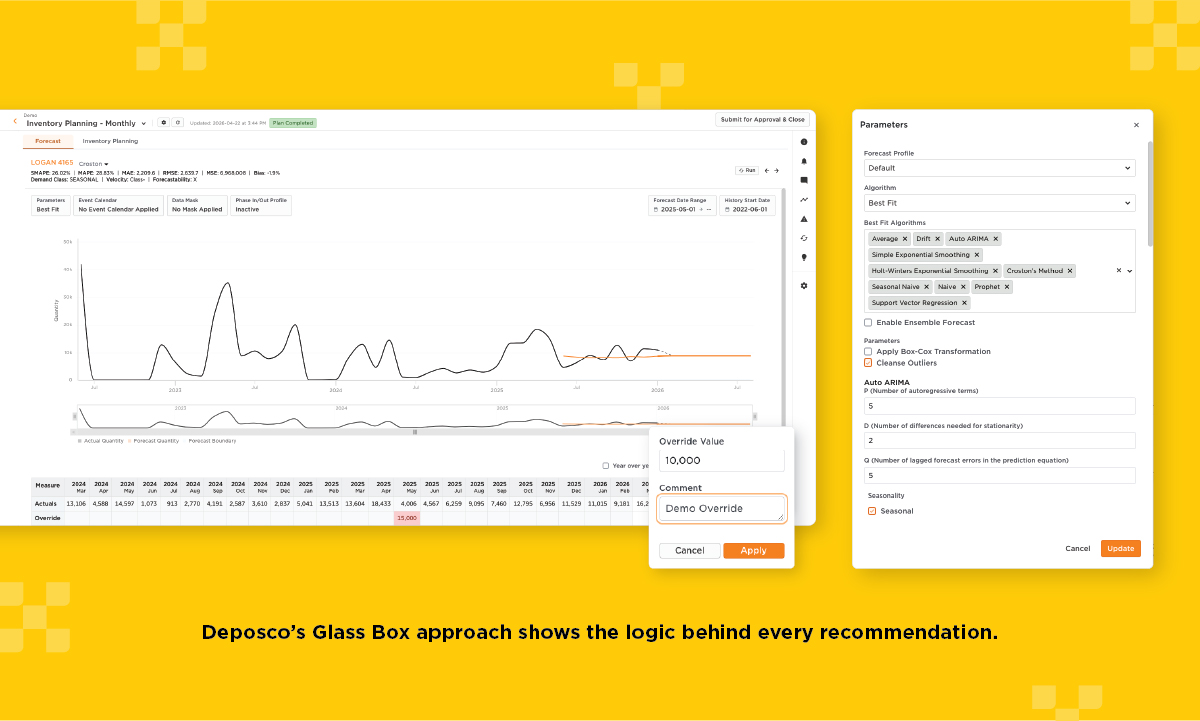
Scenario: A planner knows a major competitor is entering their category next quarter. Instead of fighting the algorithm, they apply a hierarchy-level demand adjustment on the affected SKUs, and the forecast reflects their insight, with the rationale documented for the next planning cycle.
Key feature #4: Unified platform connecting planning, execution, and supply chain intelligence
Gap: Standalone planning tools require you to bolt together forecasts, purchasing, warehouse operations, and executive reporting across different systems. Data lives in different places, and decisions get made with different numbers.
How: Deposco connects Supply Chain Planning (SCP), Warehouse Management (WMS), and Supply Chain Intelligence (SCI) on one platform. Bright Forecast runs the demand math. Bright Inventory automates time-phased planning and dynamic safety stock. Bright Source handles supplier selection, automatic PO generation, and ASN tracking. SCI Inventory Intelligence puts a dollar figure on inventory decisions and benchmarks performance against anonymous peer data. Executives finally get the report card they’ve been asking for.
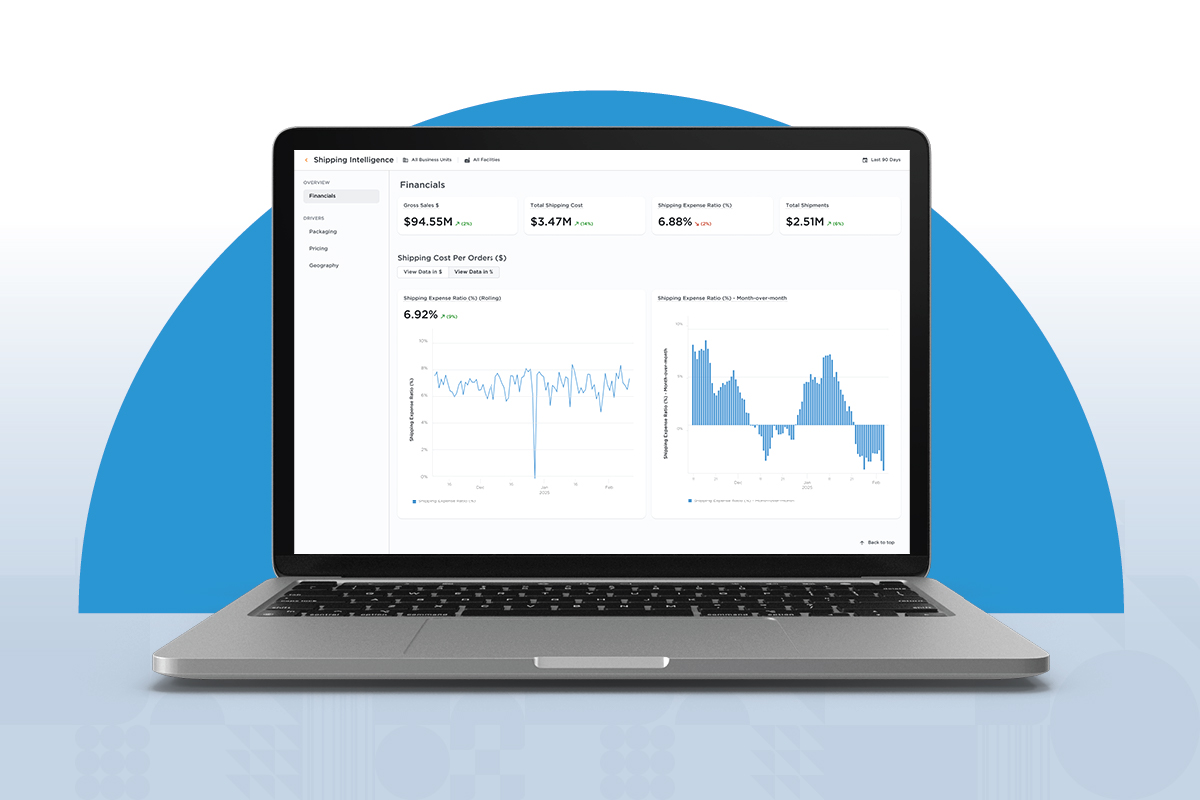
Scenario: A CPG brand’s VP of Operations walks into her Monday planning meeting. Her demand planner has been fighting a stockout on a fast-mover; her warehouse manager says receiving just flagged a late PO from a key supplier; her CFO wants to know why inventory turns slipped last quarter. With three separate tools, that meeting becomes three conflicting conversations. On Deposco, all three people are looking at the same data. The planner sees exactly which SKUs are at risk, the warehouse team sees the inbound exceptions that matter, and the CFO sees benchmarked performance against peer companies and where capital is misallocated. One conversation, one set of numbers, one action plan.
Spreadsheets and “black box” legacy tools shouldn’t be the ceiling for your growth. Experience the power of 12+ AI forecasting models and real-time inventory transparency with a practitioner-grade demo tailored to your specific SKU complexity.
2. NetStock — Best for SMB and lower mid-market replenishment
BEST FOR: Smaller businesses and lower mid-market companies looking for automated demand forecasting and inventory optimization without the implementation cycle of a larger platform.
Overview
NetStock is a demand forecasting and inventory optimization platform positioned for the small and lower mid-market segment. Companies use it to automate reorder point calculations, reduce excess stock, and replace manual inventory management practices. It operates as a standalone planning layer that integrates with common ERPs.
Features & capabilities
- Machine learning demand forecasting that evaluates multiple models per SKU, accounting for seasonality, trends, and promotions
- Dynamic safety stock that recalibrates based on supplier lead times, demand variability, and service level targets
- Pivot Forecasting® supporting top-down, bottom-up, and middle-out planning by product, channel, customer, or region
- Onboarding model combining a dedicated onboarding specialist with a self-service Learning Academy
3. Slimstock — Best for retail and promotional planning
BEST FOR: Retail, wholesale, and distribution businesses (particularly in European markets) looking for mature promotional planning and integrated S&OP capability.
Overview
Slimstock is a supply chain planning platform with roots in European retail and distribution. It focuses on demand and supply planning, replenishment, and integrated business planning, with strength in promotion-heavy categories and full product lifecycle forecasting.
Features & capabilities
- AI and ML-driven forecasting across the full product lifecycle, including seasonal items, promotions, and new product introductions
- Integrated S&OP and IBP module aligning demand, supply, and financial planning across business functions
- Promotional planning capabilities oriented toward retail and wholesale distribution
- Consultant-led implementation model with dedicated deployment support
4. StockIQ — Best for distributors and manufacturers
BEST FOR: Distribution and manufacturing companies with heavy promotional activity and a need for SIOP (sales, inventory, and operations planning) alignment.
Overview
StockIQ is a supply chain planning platform targeting distributors and manufacturers. It focuses on forecasting, replenishment, and sales-inventory-operations planning, with a particular emphasis on promotion and event modeling.
Features & capabilities
- Statistical ensemble forecasting that combines multiple techniques and selects a best-fit model per SKU
- Replenishment planning with dynamic safety stock, automated PO recommendations, and supplier scorecards
- Promotion and event modeling that adjusts inventory plans for marketing activity
- SIOP module aligning sales forecasts with inventory and operational plans across finance, operations, and supply chain teams
5. EazyStock — Best for SMB inventory optimization layered on an existing ERP
BEST FOR: Smaller businesses with a stable ERP in place that need to add demand forecasting and automated replenishment capabilities.
Overview
EazyStock is an inventory optimization platform designed to sit on top of an existing ERP. It focuses on automating reorder points, safety stock, and order quantities for companies whose ERP lacks native planning capability.
Features & capabilities
- ML-driven forecasting with automated reorder point, safety stock, and optimal order quantity calculations
- Dynamic ABC classification that segments inventory across demand type, sales velocity, and demand volatility
- What-if scenario planning simulating inventory and cash flow impact of policy changes
- ERP-layered architecture designed to extend an existing system rather than replace it
6. Kinaxis — Best for global enterprise concurrent planning
BEST FOR: Large, global enterprises running complex supply chains across multiple business units, product lines, and geographies.
Overview
Kinaxis is an enterprise supply chain planning platform focused on concurrent planning across global networks. It serves large businesses with mature internal supply chain functions, particularly in manufacturing and life sciences.
Features & capabilities
- Concurrent planning engine that allows demand, supply, inventory, and capacity plans to update simultaneously
- Scenario simulation for risk assessment, disruption planning, and capacity optimization
- Global network modeling across business units, product lines, and geographies
- Mature AI assistant capabilities for planning workflows
7. Blue Yonder — Best for large enterprise with complex networks
BEST FOR: Large retailers, manufacturers, and 3PLs with complex global operations and the internal resources to run an enterprise-scale platform.
Overview
Blue Yonder is an enterprise supply chain platform covering planning, execution, and commerce. It serves large retailers, manufacturers, and 3PLs and offers deep configurability across a broad capability set.
Features & capabilities
- End-to-end planning suite covering demand, supply, inventory, and S&OP
- Integration with execution modules including WMS and TMS
- AI/ML capabilities including a natural language assistant
- Deep configurability for large, complex environments
Supply chain planning software comparison table
Capability details reflect publicly available information and vendor documentation as of April 2026. Features vary by scope, tier, deployment model, and customer size. Confirm current details directly with each vendor.
How to choose the right supply chain planning software
The right platform depends on where your business sits today and where it’s going next.
- If you have dedicated planners and real inventory complexity, Deposco is the strongest fit for mid-market SCP. Enterprise-grade forecasting, multi-echelon optimization, and a unified platform sized for mid-market businesses, with a proof of concept you can see before you sign.
- If you’re a smaller business without a dedicated planner, NetStock or EazyStock cover the core functional areas at a lower tier.
- If your business is anchored in retail or promotional planning (particularly in European markets), Slimstock brings depth in that space.
- If you’re a distributor or manufacturer with heavy promotional activity, StockIQ is worth evaluating for its SIOP capability.
- If you’re a global enterprise running concurrent planning across many business units, Kinaxis or Blue Yonder fit that scale.
Why Deposco for mid-market supply chain planning
For mid-market companies, Deposco closes the gap between spreadsheets and enterprise platforms. You get 12+ forecasting models, multi-echelon optimization, Glass Box transparency, and a unified platform that connects planning to warehouse execution and financial reporting, with a proof of concept using your own data in three hours.