What is supply chain intelligence software?
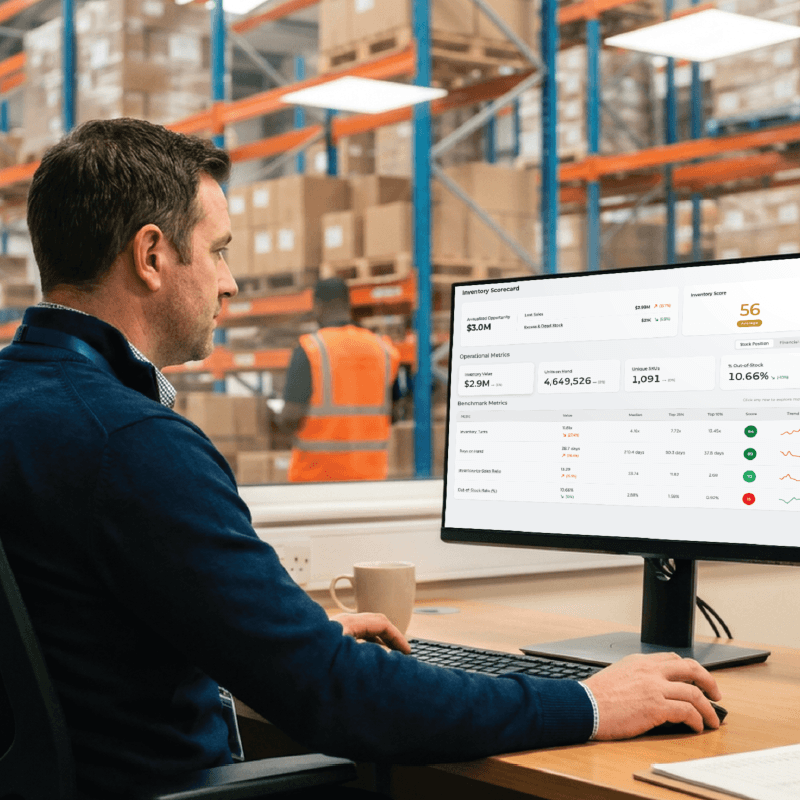
Supply chain Intelligence software is fulfillment-focused, execution-layer intelligence that benchmarks your operational performance against real industry data and uses AI to diagnose root causes of cost and performance leaks. Supply chain intelligence uses that context to create solutions to those uncovered opportunities, turning every one of your resources into the best operator in the market. It helps you reduce your three biggest fulfillment costs: shipping, labor, and inventory. It answers the question dashboards leave open: not what happened, but why it happened and what to do next.
Choosing the wrong tool in this category is expensive in a specific way. A reporting layer that only shows your own four walls will tell you a number went up. It won’t tell you whether the market moved with you, whether the cause sits in a different department than the symptom, or whether the fix you’re about to fund is the wrong one.
When operations and finance leaders start evaluating supply chain intelligence software, they’re usually dealing with a familiar set of problems:
- Labor, shipping, and inventory costs are reported in separate dashboards, so nobody can see how a decision in one area drives cost in another.
- Cost per unit is rising, and there’s no way to know whether that reflects an internal failure or a market-wide trend.
- Leadership reviews arrive weeks after the period closes, so every finding is a postmortem rather than a decision.
- Carrier invoices, labor standards, and inventory positions are managed on intuition and spreadsheets rather than benchmarked against real data.
In this guide, we’ve compared seven supply chain intelligence solutions, covering what each one measures, who it’s built for, and what sets it apart:
- Deposco Supply Chain Intelligence
- FreightWaves SONAR SCI
- Reveel
- EasyMetrics
- CognitOps
- Kinaxis
- Blue Yonder
A note on scope: “supply chain intelligence” appears in product names across several unrelated categories. This list covers execution-layer intelligence for fulfillment operations. It excludes ESG reporting tools, bill-of-materials risk platforms, consulting services, and SMB accounting add-ons that use similar naming but serve a different buyer entirely.
1. Deposco Supply Chain Intelligence
BEST FOR: Mid-market brands, retailers, and 3PLs running fulfillment on the Deposco platform who need shipping, labor, and inventory intelligence benchmarked against a live network, without a BI implementation project
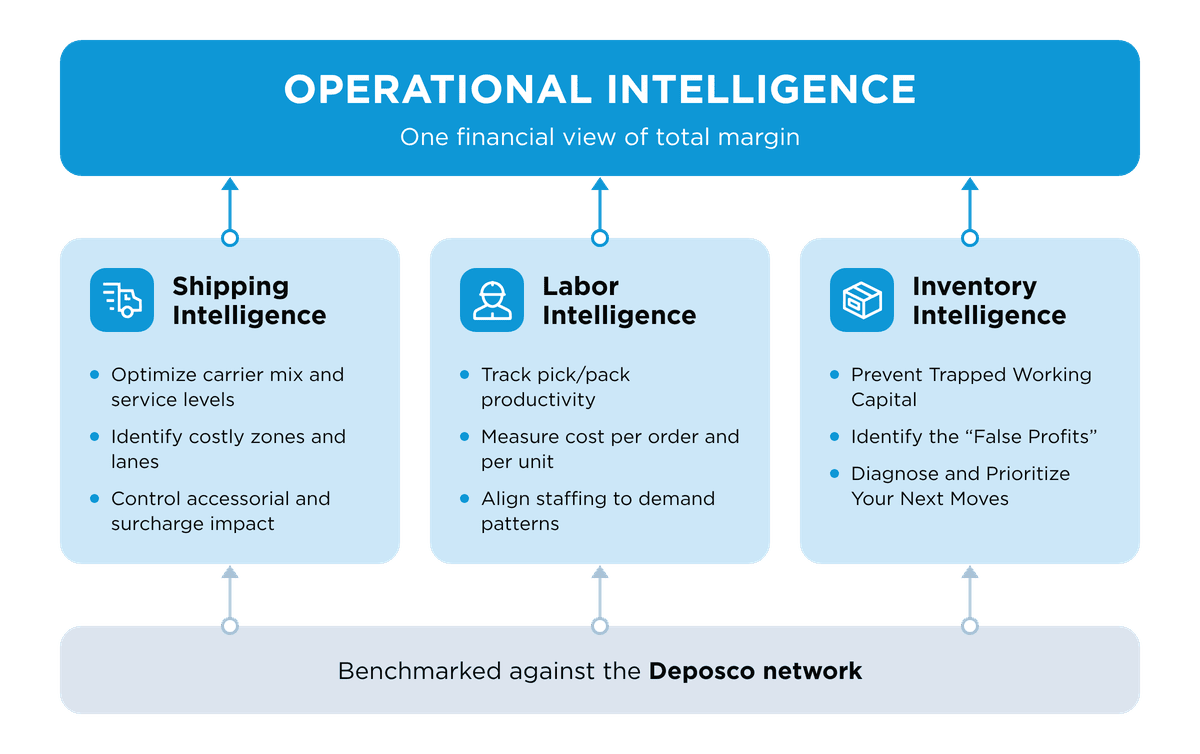
Deposco Supply Chain Intelligence (SCI) is an intelligence suite built directly into the Deposco platform, connecting operational execution to profitability across the three biggest fulfillment costs: shipping, labor, and inventory. Because the intelligence layer runs on data the platform already generates, value starts on Day One: no data mapping project, no pipeline to build, no separate vendor to integrate.
Benchmarking against a live network, not a survey
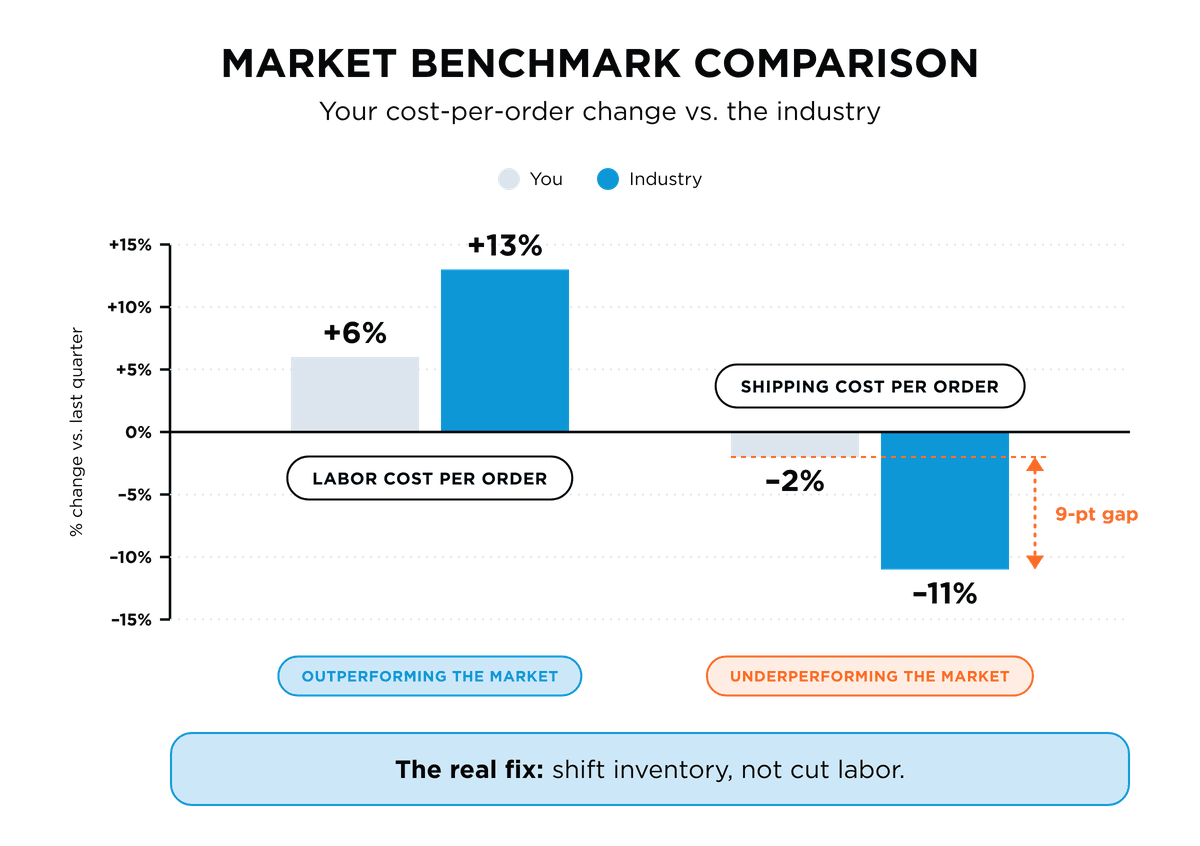
The gap: Most analytics tools can only compare your operation against its own history. If your labor cost rises 6%, you have no way to know whether that’s a failure or an outperformance.
How Deposco solves it: SCI benchmarks your shipping rates, labor performance, and inventory position against the Deposco network: more than $85B in processed GMV and 5,500+ brands. Shipping costs are compared like-for-like by weight and zone bucket against comparable shippers. Labor standards are drawn from scan-level records across 60M+ tracked labor hours, matched by process, order type, and pick method. Comparisons run against peer cohorts: operations of similar size, order profile, and vertical, because a benchmark is only as useful as how well the operations behind it match yours.
Scenario: A customer flagged labor cost per order up 6% quarter over quarter, and leadership prepared to spend weeks driving the number down. SCI showed the industry average had risen 13%. They were outperforming the market on labor, while their shipping cost per order had dropped by only 2% compared with an industry decline of 11%. The real fix was shifting inventory within the network, not cutting labor. Without market context, you fix what isn’t broken and miss what is.
Causal AI that explains why, not just what
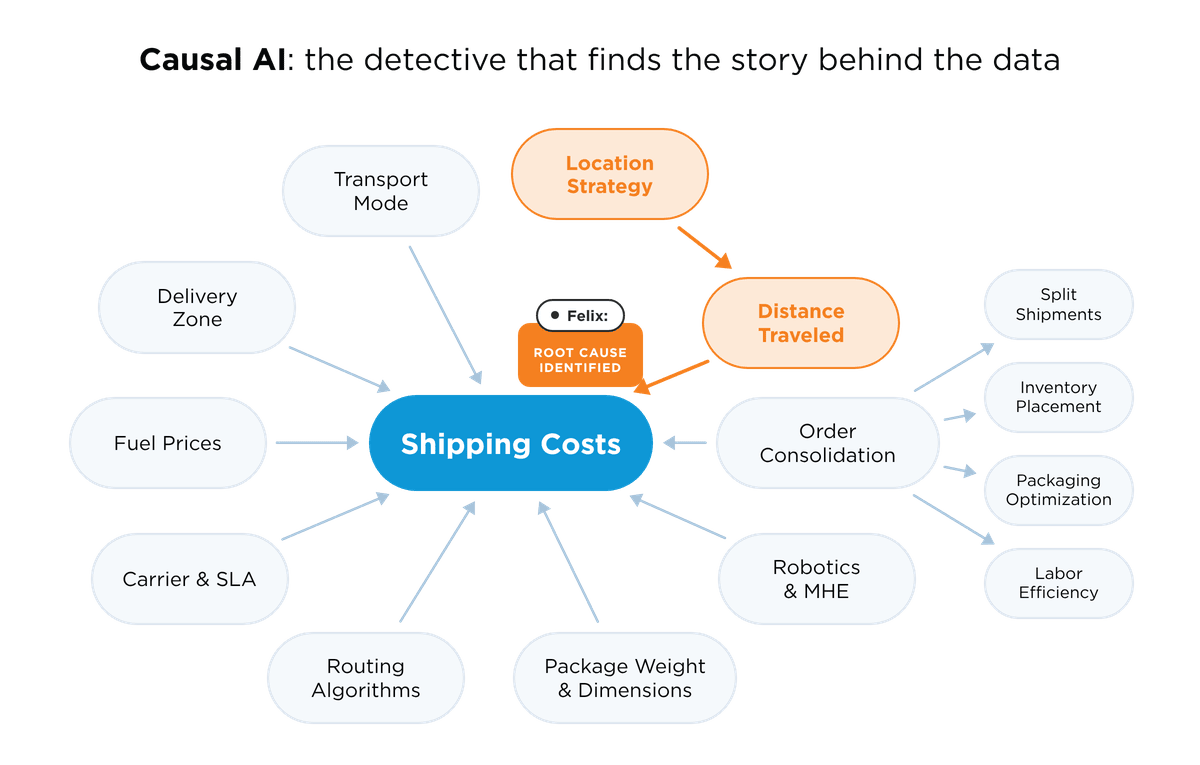
The gap: Traditional dashboards report symptoms. The analysis of what actually caused a margin change is done manually weeks later in a business review.
How Deposco solves it: SCI applies Causal AI that combines a model of known operational relationships (priority shipping and ship-from distance drive shipping cost; order profiles drive pick time; etc.) with your operation’s data to identify and isolate the business drivers behind a performance change, then delivers clear recommendations.
Scenario: Imagine a CFO at a DTC brand watching contribution margin slip during a promotion-heavy quarter. Instead of commissioning an analysis, she opens a diagnosis that traces the erosion to a specific interaction: promotional order profiles required more pick time and pushed weekend shifts into overtime. The conversation with operations starts from the cause, not the symptom.
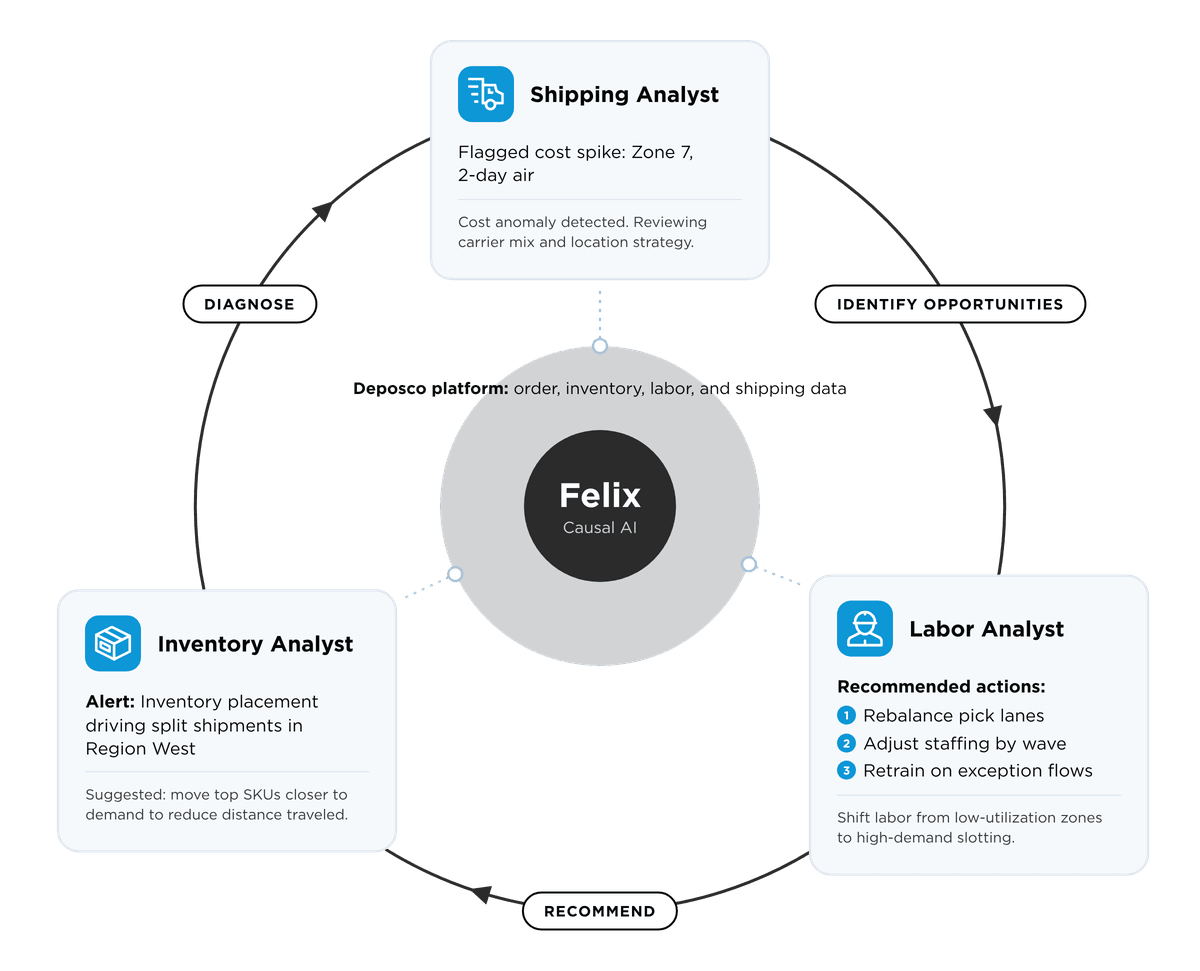
Felix: a team of AI expert agents on your data around the clock
The gap: Most vendors in this space now market an AI analyst. What matters is what feeds it. An agent that can see only one data silo can reason about only one data silo.
How Deposco solves it: Felix is a team of AI expert agents available within the platform, with analyst agents covering shipping, labor, and inventory in production today. Felix runs on native visibility across order, inventory, labor, and shipping context, layered with Deposco’s Causal AI, following a consistent pattern: diagnose the root cause, identify opportunities against network benchmarks, and recommend specific adjustments.
Scenario: From Deposco’s launch announcement: when a flash sale drives order volume up 40%, Felix doesn’t just report the spike. It calculates that those orders averaged $35, required 2.3x more pick time than standard orders, pushed weekend shifts into overtime, and destroyed margin on over half of transactions — in time to adjust the promotion rather than three weeks later in a business review.
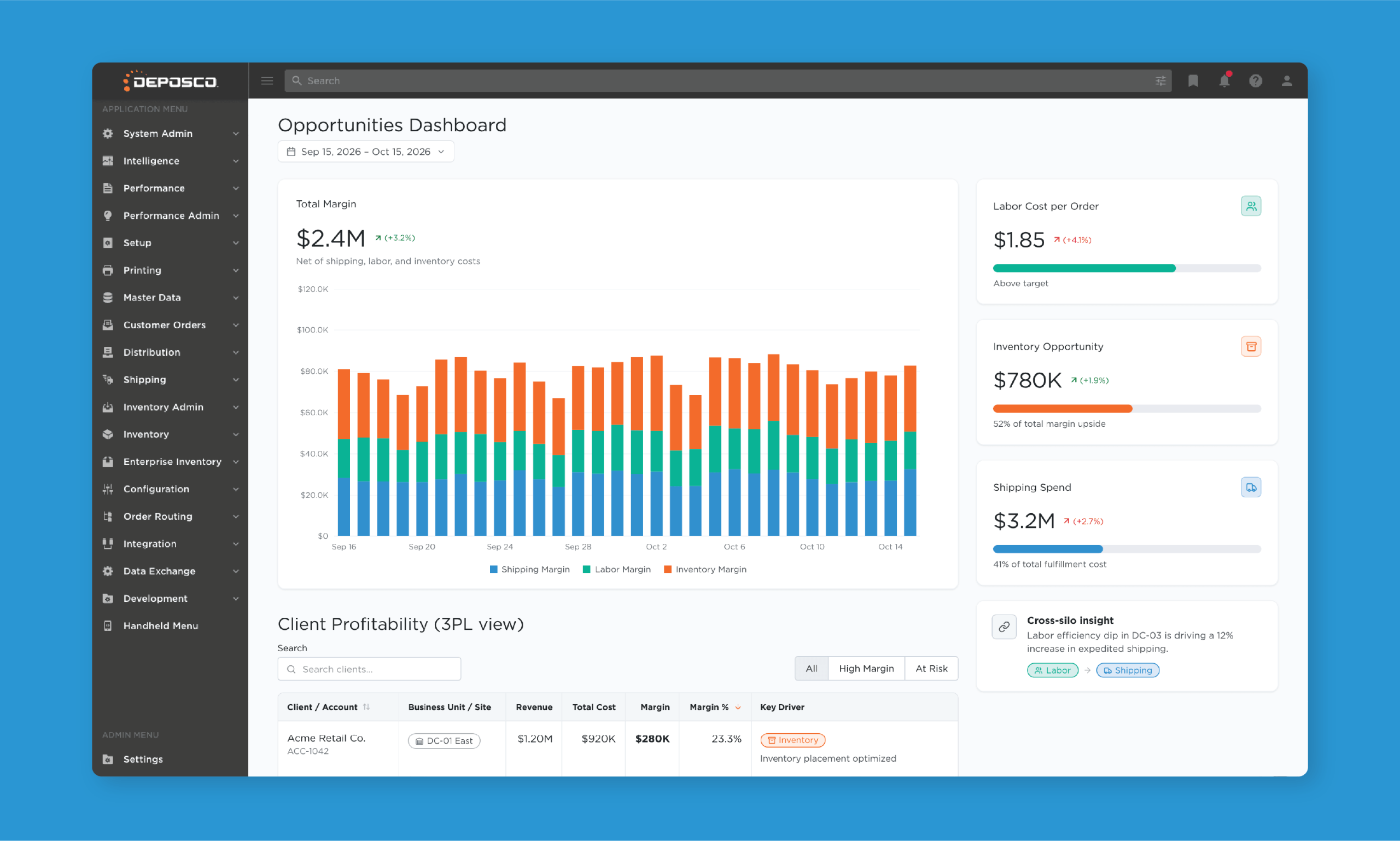
One financial view across shipping, labor, and inventory
The gap: Optimization in isolation is just a cost shift. Squeezing labor can inflate shipping. Padding inventory can quietly destroy margin. Departmental dashboards hide these interactions.
How Deposco solves it: Operational Intelligence, the cross-pillar layer of the suite, unifies labor cost per order, inventory opportunity, and shipping spend into a single financial view of total margin and surfaces cross-silo connections, such as a dip in labor efficiency that forces expensive expedited shipping. Executives get market-benchmarked visibility without waiting for end-of-month reports.
Scenario: Imagine a VP of Operations at a multi-facility 3PL preparing a quarterly client review. Instead of stitching together three exports, he opens a single view showing which client accounts are profitable after accounting for true labor, shipping, and storage costs, and where a shift in inventory placement would eliminate expedited shipping spend entirely. Deposco customers have scaled on this foundation: ITB Fulfillment grew order volume 9x in year one with 100% uptime and an error rate under 1%, and Plant Therapy tripled productivity while order volume grew 7x with fulfillment under 24 hours. The intelligence layer is newer than the platform underneath it: SCI launched in 2025 on data the platform has been generating for years.
2. FreightWaves SONAR SCI
FreightWaves SONAR SCI is a freight market intelligence platform focused on transportation procurement. Despite sharing an acronym with the supply chain intelligence category, it serves a different job: external market data on freight rates and capacity, primarily for full-truckload and freight-heavy shippers, rather than intelligence built from your own fulfillment operation.
Features and capabilities
- Spot and contract rate data: Market rate visibility across freight lanes to inform procurement and bid strategy.
- Lane analytics: Lane-level analysis to compare carrier pricing and identify procurement opportunities.
- Capacity indicators: Market capacity data to anticipate tightening or loosening conditions.
- Benchmarking for freight procurement: Compares contracted freight rates against prevailing market conditions.
3. Reveel
Reveel is a parcel spend management platform that analyzes carrier agreements and shipping invoices to help shippers reduce parcel costs. In 2026 the company launched Reveel IQ, marketed as AI-driven shipping intelligence, extending its analytics across parcel contracts and invoice data.
Features and capabilities
- Parcel contract analysis: Models carrier agreement terms to identify negotiation opportunities.
- Invoice auditing: Reviews parcel invoices for billing discrepancies and refund opportunities.
- Shipping analytics: Reporting on parcel spend patterns across carriers and service levels.
- Rate simulation: Models the impact of alternative carrier rate structures on historical shipment data.
4. EasyMetrics
EasyMetrics is a standalone labor management platform oriented toward warehouse labor cost analytics. It ingests data from an operation’s existing systems to build labor standards and cost-to-serve visibility, and has added AI-driven analysis to its platform over the past year.
Features and capabilities
- Labor cost analytics: Cost-to-serve reporting that connects labor activity to financial outcomes.
- Labor standards: Builds performance standards from accumulated operational data.
- Incentive and coaching support: Performance visibility to support pay-for-performance and coaching programs.
- Cross-WMS integration: Enables data exchange across warehouse management systems.
5. CognitOps
CognitOps is a warehouse operations intelligence platform that consolidates signals from warehouse systems into a real-time operating picture for distribution centers. It focuses on in-shift orchestration: helping operations teams see building status, predict bottlenecks, and direct labor during the day.
Features and capabilities
- Real-time operations visibility: A live view of warehouse status across orders, labor, and workflow.
- Predictive workload analysis: Anticipates bottlenecks and completion risk during the shift.
- Labor orchestration guidance: Recommends where to shift labor to keep the building on plan.
- Multi-site reporting: Rolls up operational metrics across distribution centers.
6. Kinaxis
Kinaxis is an enterprise supply chain planning platform centered on its concurrent planning approach, in which demand, supply, and inventory plans update together in response to change. It occupies the planning layer of the supply chain rather than the fulfillment execution layer: its intelligence concerns what the plan should be, not what execution is costing.
Features and capabilities
- Concurrent planning: Demand, supply, and inventory planning that recalculates together as conditions change.
- Scenario modeling: Simulates supply chain decisions and disruptions before committing.
- Demand and supply balancing: Multi-tier visibility across supplier networks.
- Planning analytics: Dashboards and analytics oriented toward planners and supply chain leadership.
7. Blue Yonder
Blue Yonder is an enterprise supply chain software provider with a broad portfolio spanning planning, warehouse management, transportation, and retail. Its analytics and intelligence capabilities sit within that larger ecosystem, built primarily for large global operations with substantial IT resources and program-based implementation timelines.
Features and capabilities
- Planning and forecasting suite: Demand and supply planning across global, multi-tier networks.
- Warehouse and labor modules: Execution and labor management within the broader platform.
- Transportation management: Freight planning and execution for enterprise logistics networks.
- AI initiatives: Cognitive and agent-based capabilities being rolled out across the portfolio.
Comparison at a glance
This comparison is based on publicly available information as of November 2026 and reflects each vendor’s primary positioning. Capabilities vary by product tier, configuration, and use case — verify details directly with each vendor during evaluation.
How Deposco can help
Most of the tools in this category answer one question well. Freight market platforms tell you what the market pays. Parcel auditors tell you what you were billed. Labor tools tell you what your workforce produced. Planning platforms tell you what the plan should be.
Deposco Supply Chain Intelligence answers the question that sits above all of them: where, across shipping, labor, and inventory together, is your operation leaking margin — and what should you do first?
For operations leaders, that means market context on every number before you commit a quarter to fixing it. For finance leaders, it means one financial view connecting labor cost per order, inventory opportunity, and shipping spend to total margin. For 3PLs, it means client-level cost visibility that turns transparency into a retention and growth tool.
And because SCI runs natively on the Deposco platform, the intelligence connects directly to execution: the same platform that runs the warehouse can act on what the analysis finds. That’s the foundation customers like ITB Fulfillment and Plant Therapy scaled on, and a structural difference: the intelligence and the execution live in the same platform.