
The best 3PL billing software in 2026 is billing that lives inside the warehouse system, because every invoice line starts as a warehouse event. Deposco leads for mid-market 3PLs that need billing, WMS, and client portal on one platform, with Extensiv, Camelot, Logiwa, and Made4net offering billing modules suited to different operation sizes. This guide compares all five on how completely they capture billable activity, how flexibly they price it per client, and how much of the month-end close they remove.
Where 3PL margin actually leaks
A 3PL’s invoice is a reconstruction of everything the warehouse did for one client in one period: receipts by pallet or unit, storage by day and location type, picks, packs, kitting, relabeling, returns inspection, and every shipment. When the billing system sits outside the WMS, that reconstruction happens in spreadsheets at month-end, from reports that were not designed to be rate cards.
When finance and operations leaders at 3PLs go looking for billing software, the problems usually sound like this:
- Value-added services such as kitting and relabeling get billed from memory or not at all because nothing logged them as a chargeable event.
- Every client has a different rate card, and applying twenty of them by hand turns close into a multi-day project.
- Clients dispute invoices because the line items do not show the activity behind them, and each dispute delays cash.
- Leadership cannot see which clients are profitable because labor cost and billed revenue live in different systems.
In this guide, we evaluated five 3PL billing solutions on those problems:
- Deposco (Best for mid-market 3PLs that want billing, WMS, and client portal on one platform)
- Extensiv Billing Manager
- Camelot 3PL Software
- Logiwa
- Made4net
How we evaluated 3PL billing software
Each solution was assessed on four dimensions that determine whether billing supports growth or drags on it:
- Activity capture. Is every billable event recorded at the moment it happens in the warehouse, including value-added services?
- Rate card flexibility. Can each client carry its own rates, minimums, tiers, and storage calculation without custom development?
- Close speed. How much of month-end reconciliation does the system remove?
- Transparency and profitability. Can clients see the activity behind each invoice line, and can leadership see margin by client?
Evaluations reflect publicly available vendor documentation, customer references, and Deposco’s implementation experience with mid-market 3PLs as of August 2026. No vendor paid for placement. Conduct independent evaluation and proof-of-concept testing before selecting a platform.
1. Deposco
Best for: mid-market 3PLs that want to stop reconstructing invoices at month-end and start closing from the activity log.
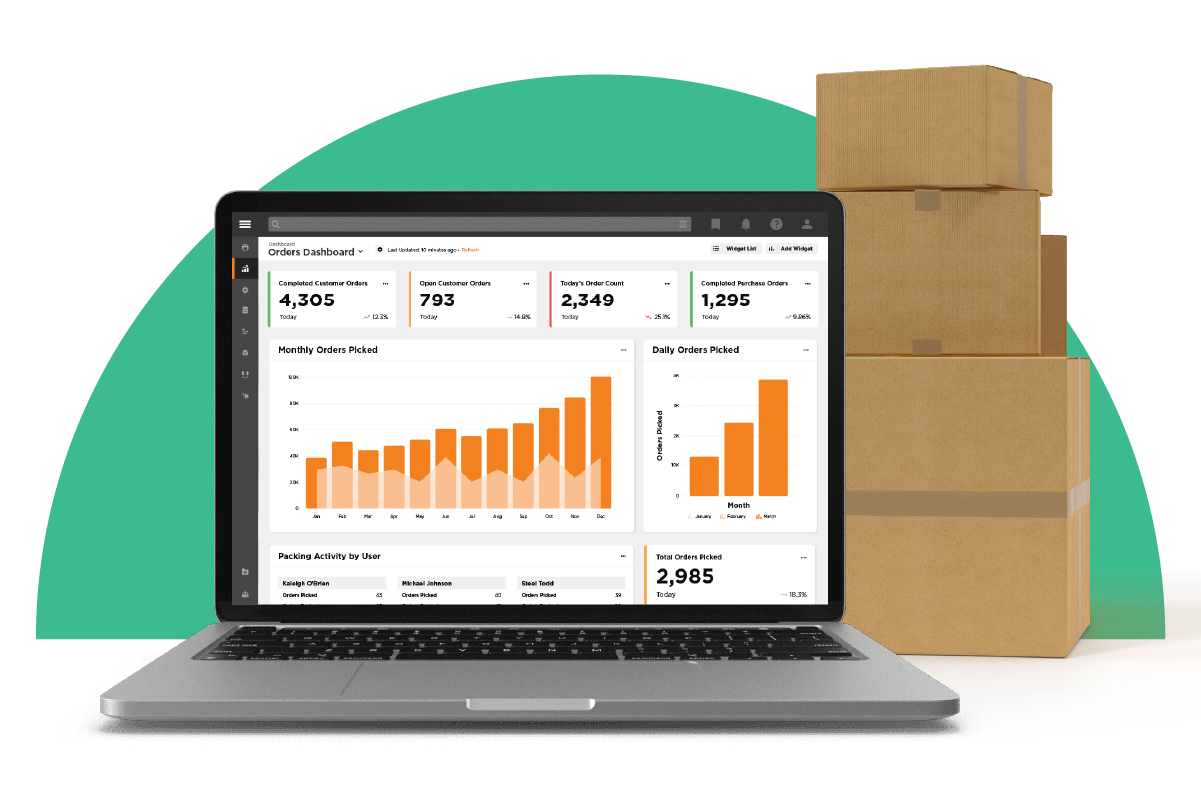
Deposco’s 3PL billing is not a module bolted beside the warehouse system; it is the same system. Every receipt, putaway, pick, pack, kit, and shipment writes a billable event as it executes, each client carries its own rate card, and clients see the activity behind every invoice line in Bright Portal. Nimbl Fulfillment cut four days from its billing cycle and grew order volume 64% in its first three months on the platform.
Billable events captured at execution
Gap: Billing systems that import warehouse data after the fact can only bill what the export contains. Activity that was never logged as chargeable, especially value-added work, disappears between the floor and the invoice.
How: In Deposco, the transaction that moves inventory is the transaction that creates the billable event. There is no export, no mapping step, and no second system to reconcile. The result: the invoice matches the floor. Deposco’s guide to 3PL billing walks through the event model.
Scenario: A controller at a 3PL with 18 clients used to find out about custom kitting jobs when the ops manager mentioned them in passing, usually after the invoice went out. On Deposco, the kitting task the floor completed on Tuesday is a priced line item by Tuesday afternoon, and the controller has stopped issuing corrected invoices.
Rate cards that match the contract
Gap: Every 3PL contract prices storage, handling, and services differently. When the billing tool supports one rate structure, finance maintains the exceptions in spreadsheets, and the spreadsheets become the system of record.
How: Deposco holds a rate card per client covering storage by pallet, bin, or cubic volume, handling by unit or order, tiered pricing, minimums, and value-added services, applied automatically to the activity log. Contract changes are configuration, not development.
Scenario: A 3PL renegotiates a client’s contract mid-year: storage moves from per-pallet to per-cubic-foot, and a volume discount kicks in above 15,000 orders a month. The controller updates the rate card in an afternoon. The next invoice run applies the new structure to the activity log without a formula being touched.
Close in days, not weeks
Gap: When billing is a reconciliation exercise, month-end close is a bottleneck for cash. Invoices go out late, disputes come back, and the finance team spends the first week of every month looking backward.
How: Because the activity log is already priced, Deposco’s invoice run is a review step rather than a build step. Invoices can be generated per client on any cadence, and exported to accounting through pre-built integrations including QuickBooks Online and NetSuite.
Scenario: A CFO at a growing 3PL tracks days-to-invoice as a cash metric. Before Deposco, the number was nine. After moving billing into the WMS, invoices go out on the second business day, cash arrives a week earlier on average, and the finance team’s first week of the month is spent on forecasting instead of reconciliation.
Transparency that ends the dispute call
Gap: Clients dispute what they cannot see. An invoice line that reads “handling: 4,312 units” without the orders behind it invites a phone call, and each call delays payment.
How: Bright Portal exposes billing detail to the client alongside inventory, orders, and SLA performance. The client’s finance team can trace a line item to the activity that generated it before the invoice arrives. Executive Intelligence gives 3PL leadership the other side of the same data: billed revenue and labor cost by client.
Scenario: A 3PL’s largest client used to send a spreadsheet of questions with every invoice. After Bright Portal, the client’s AP team checks the activity detail themselves, the monthly question list disappears, and the 3PL’s general manager can see for the first time that this client’s kitting-heavy program runs at half the margin of the account below it.
Considerations: 3PLs on accounting platforms outside the pre-built integration library should confirm export formats during evaluation.
Walk through client onboarding, billable activity capture, and Bright Portal with a 3PL systems expert. Built for the midmarket operator adding clients faster than headcount.
2. Extensiv Billing Manager
Extensiv markets Billing Manager as a companion module to 3PL Warehouse Manager, automating client invoicing from activity captured in the WMS. It is positioned for SMB and lower mid-market 3PLs already on the Extensiv suite.
- Activity-based invoicing fed by 3PL Warehouse Manager transactions
- Configurable rate structures per client
- Invoice generation and export to accounting systems
- Client portal access to billing information
3. Camelot 3PL Software
Camelot markets Excalibur WMS, a 3PL-exclusive warehouse system built on Microsoft Dynamics 365 Business Central, with billing and client portal included. It is positioned for small to mid-size 3PLs already on the Microsoft stack, and publishes entry pricing.
- Billing built on Business Central’s financial foundation
- Per-client rate configuration for storage, handling, and services
- Client portal with inventory and billing visibility
- Power BI reporting through the Microsoft ecosystem
4. Logiwa
Logiwa markets billing as part of Logiwa IO, its fulfillment management system for high-volume DTC brands and 3PLs. Billing configuration follows the same no-code workflow approach the platform uses elsewhere.
- Multi-client billing configured through workflow rules
- Activity-based charges for storage, handling, and shipping
- Client-specific portals with billing visibility
- Integrations to accounting platforms through its app store
5. Made4net
Made4net markets a 3PL billing module within the 3PL edition of its SCExpert suite, alongside WMS, yard, labor, and transportation. It is positioned for mid-market to enterprise operators that want billing inside a broader execution platform.
- Activity-based billing for storage, handling, and value-added services
- Client-specific rate structures
- Client portal for inventory and billing visibility
- SaaS or on-premises deployment
How Deposco can help
Every solution here can generate an invoice. The question is how much of the work between the warehouse floor and that invoice the system does, and how much the finance team still does by hand.
If you own finance: Deposco prices the activity log as it is created, applies each client’s rate card automatically, and exports to QuickBooks or NetSuite. Nimbl Fulfillment cut four days from its billing cycle.
If you own operations: value-added work the floor completes is billed the same day, and Labor Intelligence shows what that work cost, so pricing conversations start from data.
If you own client relationships: Bright Portal puts invoice detail in front of the client before the invoice does, and the dispute call turns into a renewal conversation.
Billing is the one moment every month when a 3PL’s client evaluates the relationship in dollars. Getting it right, on time, and without a phone call is retention work. Pull last quarter’s days-to-invoice and dispute count, then see what billing that starts on the warehouse floor looks like in production.
ITB Fulfillment grew 9x in year one. Derby onboards new clients in 2 hours. Nimbl cut four days from month-end close. Schedule a live demo with a 3PL systems expert.
Evaluation Disclaimer
The evaluations, comparisons, and recommendations in this article represent opinions based on limited publicly available information, selected customer reviews, analyst reports, and industry publications as of September 2026. These assessments do not constitute comprehensive evaluations of all available WMS solutions or reflect the complete range of user experiences across different implementations.