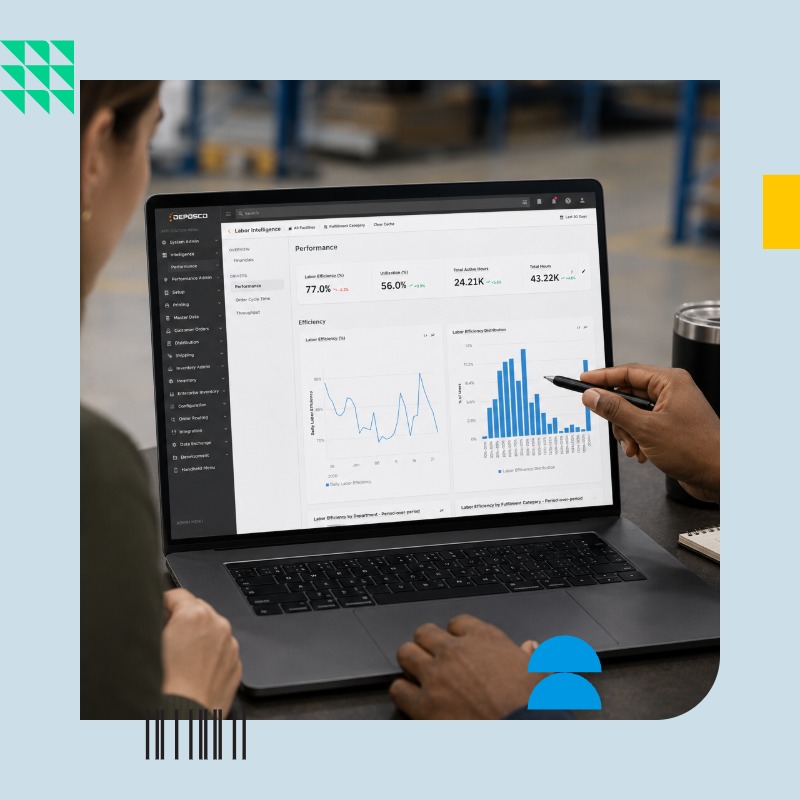
Most warehouse operations track one labor metric well. Almost none track both.
The two metrics that actually tell you what’s happening with your labor are efficiency and utilization. They sound similar. They measure different things. Confusing them — or only tracking one — is one of the most common and costly mistakes in warehouse labor management.
Efficiency: how well are your people working?
Efficiency measures performance during active work time. How many orders per hour is a picker processing? How does that compare to the standard for that pick method and order type? Is performance trending up or down over time?
Efficiency is the metric most operations focus on. It’s intuitive and visible: you want your people to work well when they’re working. Coaching conversations, performance reviews, and incentive programs are almost always built around efficiency metrics.
Efficiency is important. It is not sufficient.
Utilization: are your people actually working?
Utilization measures what percentage of paid shift time workers are actively processing orders. It captures the gaps — time clocked in but not scanning, not picking, not packing. Breaks, shift transitions, waiting for work, post-break reactivation, system logins, equipment changeover.
Some of that gap is planned and unavoidable. An operation running at 80-85% utilization is doing very well — the remaining 15-20% accounts for lunch, breaks, and legitimate non-production time. But many operations run at 60-70% utilization without knowing it. That’s up to 40% of paid shift time producing nothing.
And here’s the problem: utilization doesn’t show up in your efficiency numbers. An 80% efficient worker who is only active 65% of the time looks good on efficiency reports and terrible on the bottom line. You don’t see it unless you’re tracking both.
An 80% efficient worker who is only active 65% of the time looks great on efficiency reports and terrible on the bottom line.
How AI connects the two
Tracking both metrics is the starting point. Understanding how they interact — and what’s driving the relationship — is where AI adds the most value.
Felix doesn’t just report utilization and efficiency side by side. It reasons across them. When a utilization dip follows a specific pattern — post-break, consistent across the same shift, tied to a particular work area — Felix connects those dots and surfaces the likely cause. When efficiency drops on complex orders but holds steady on simple ones, Felix flags it as an order-type-specific issue rather than a performance issue, which points toward process rather than personnel.
That distinction matters enormously for how you respond. Coaching a worker for low efficiency when the problem is actually a utilization gap caused by poor work queue distribution is the wrong intervention. Felix helps you make the right call.
What to do with this
Start by getting visibility into both numbers — at the facility level, the team level, and the individual level. Then look at your utilization gap first. It’s often larger than expected, and frequently fixable with operational adjustments rather than personnel changes: staggered breaks, pre-loaded work queues, reduced system login time.
Then look at efficiency by order type and process. Don’t look at blended averages — they hide the variation that matters most.
Efficiency and utilization. Both numbers. Every shift. That’s the foundation. AI is what lets you act on what you find before it costs you another week of margin.
An 80% efficient worker who’s only active 65% of the shift looks great on your efficiency report and terrible on your bottom line. Labor Intelligence tracks both numbers — at the facility, team, and individual level — and Felix reasons across them to tell you whether you’re looking at a coaching problem or a process problem.