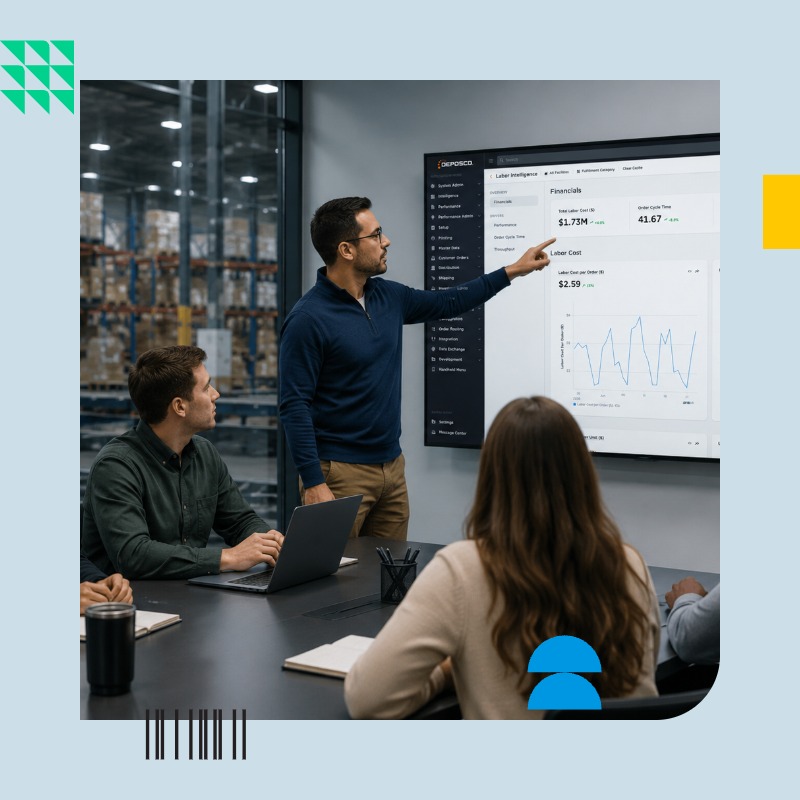
Getting leadership to care about labor management isn’t hard. Labor is the largest variable cost in the operation. Every CFO and CEO already cares about it.
Getting leadership to understand what to do about it — and to fund the tools and changes that will move the number — is harder. The conversation usually breaks down in one of two places: the data isn’t specific enough to be credible, or the opportunity isn’t framed in financial terms.
Here’s how to build a conversation that doesn’t break down.
Start With a Number They Already Care About
Don’t open with efficiency percentages. Open with labor cost per order.
Labor cost per order connects immediately to unit economics, margin, and pricing. If your CFO is thinking about whether to raise prices on a particular order type, labor cost per order is the input they need. If your CEO is thinking about whether your fulfillment operation is competitive, labor cost per order is the comparison that matters.
Most operations don’t have this number readily available. If you can walk into the room with it — broken down by order type, by facility, by shift — you’ve already changed the conversation. Labor Intelligence makes that possible without a week of spreadsheet work. Felix can produce the number on demand, in the format your leadership team will understand.
Quantify the Gap, Not Just the Problem
The mistake most operations leaders make in leadership conversations is describing the problem without pricing the opportunity. “Our multiline order efficiency is below benchmark” is a problem statement. It doesn’t tell the CFO how much it’s worth fixing.
The conversation that gets traction sounds different: “Our multiline order throughput is at 3.9 orders per hour. The platform 75th percentile is 5.2. Closing half that gap, at our current volume, is worth approximately $340,000 in recovered labor capacity annually. That’s without adding a single person.”
That number isn’t a guess. It’s AI-driven analysis from actual platform benchmark data. It has a baseline, a benchmark, a realistic target, and a dollar value. It’s fundable.
Frame It as Performance, Not Surveillance
One of the fastest ways to derail a labor management conversation with leadership is to make it sound like it’s about monitoring or cutting jobs. That’s not what labor management is.
Frame it around performance: this is about understanding where our operation is performing well and where it isn’t, so we can manage it better. The same data that surfaces a low performer also surfaces a high performer. The same AI that identifies a coaching opportunity identifies a recognition opportunity. The goal is to understand both and replicate the process patterns that high performers use.
That framing matters for leadership buy-in and for the change management conversation that follows.
Show the Roadmap, Not Just the Problem
Leadership wants to fund a plan, not a problem. Come in with a problem and you get sympathy. Come in with a plan and you get a budget.
A credible labor performance plan has three elements: a baseline (where we are), a benchmark (where we should be), and a sequence of actions with expected impact. Labor Intelligence gives you the baseline and the benchmark. Felix helps you model the actions — what happens to cost per order if you close the pick-to-pack gap, or if you shift complex orders to batch picking. The plan writes itself from the data.
The Data Makes the Case. You Make the Decision.
The best leadership conversations about labor performance aren’t advocacy exercises. They’re data presentations that let the numbers speak.
When you can show cost per order by order type, efficiency trends by shift, throughput compared to platform benchmarks, and a quantified opportunity in real dollars — all of it produced by AI that’s reasoning across your actual operational data — you don’t have to convince anyone of anything. The data does it.
Your job is to walk in with the right numbers, frame them correctly, and have a plan ready when the question is “so what do we do about it?”
Our multiline throughput is at 3.9 orders per hour, the platform 75th percentile is 5.2, and closing half that gap is worth ~$340K in recovered labor capacity” is a fundable sentence. “We should improve efficiency” isn’t. Labor Intelligence gives you the baseline and the benchmark, and Felix models the actions and the dollar impact — so the plan writes itself from your data.