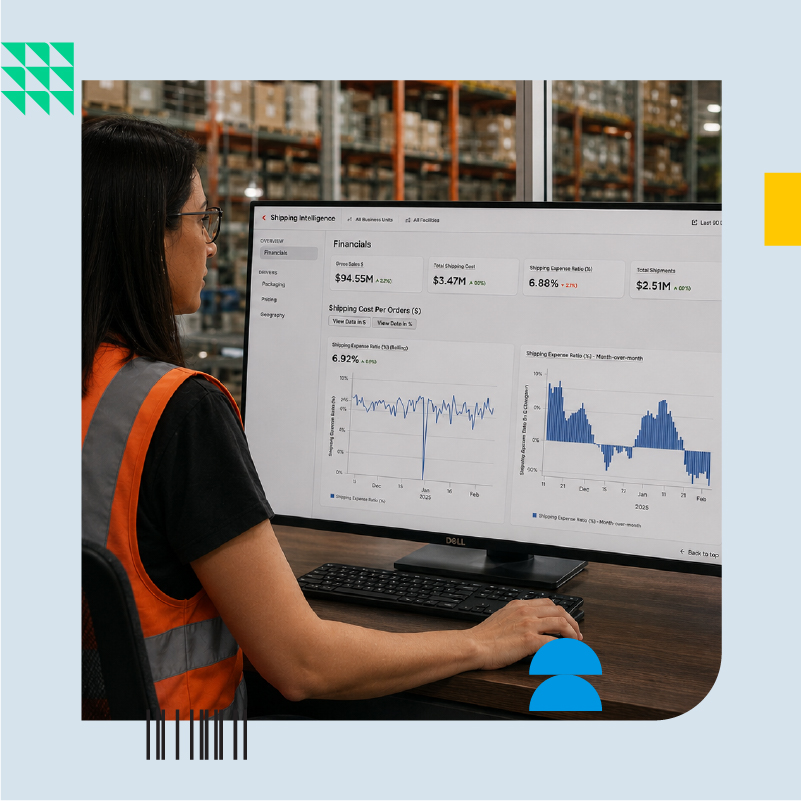
Ask most retail technology leaders whether they’ve achieved unified commerce, and they’ll say yes. The e-commerce platform talks to the warehouse. POS syncs with the ERP. The OMS is connected to fulfillment. The integrations are live, the data is moving, the boxes are checked.
Unified Commerce vs. Integrated Commerce: What’s the Difference?
Eduardo Frias, Field CTO Enterprise at Shopify, draws a line that makes a lot of those leaders uncomfortable. His test: if you have to look at two different systems or query several databases to understand the status of a single order, you don’t have unified commerce—you have integrated commerce. The distinction sounds academic. It isn’t. It’s the difference between systems that pass data to each other and systems that draw on the same truth.
Integrated commerce is what most brands actually built over the last decade. Everything is connected, but connection isn’t unity. Data moves between systems, gets transformed, gets reconciled, and quietly drifts out of agreement. And the place that drift is most expensive—and most ignored—is your shipping data.
Why Shipping Data Is the Black Box in Your Commerce Stack
Think about where shipping intelligence usually lives in a “unified” stack. Your carrier invoices arrive as PDFs or EDI files nobody fully audits. Your true cost per shipment sits in one system, your order data in another, your inventory positions in a third. When you want to know what a given order actually cost to fulfill and deliver, you’re querying multiple databases and stitching the answer together by hand. By Frias’s test, that’s not unified. That’s the black box at the center of your commerce operation—and it happens to be sitting on one of your largest variable costs.
What Unified Commerce Actually Requires From Shipping Data
This is the gap Shopify and Deposco close from opposite ends. Shopify owns the unified commerce foundation: the customer, the order, the channel, the front-end experience, all drawing on shared data. Deposco’s Supply Chain Intelligence brings that same standard to the part of the business that usually escapes it—shipping. Not another dashboard bolted onto the side, but audited, benchmarked, reconciled shipping data that agrees with the rest of your stack instead of contradicting it.
Consider what “unified” actually requires for shipping specifically. It means your shipping cost data is accurate—which means the carrier invoices feeding it have been audited against what you should have been billed, not accepted at face value. It means that cost is contextualized—benchmarked against comparable businesses, so you know whether it’s good or bad, not just what it was. And it means it’s reconciled—aligned with the same order and financial records the rest of your commerce stack runs on, so you’re not maintaining a separate, drifting version of freight truth. Miss any one of those and shipping stays a black box, no matter how many integrations you’ve lit up.
Untrusted Shipping Data Breaks the Delivery Promise
The reason this matters goes straight to the customer. Unified commerce is supposed to let you make a promise at checkout—a delivery date, a shipping cost, an availability commitment—and keep it, because every system is working from the same reality. But a delivery promise built on shipping data you can’t trust is a guess with good production values. If you don’t actually know your cost to serve by zone and ship-to state, you’re pricing shipping blind. If you can’t see which zones are slow or expensive, you’re making promises you can’t reliably keep. The black box doesn’t just cost you margin. It undermines the exact customer experience unified commerce exists to deliver.
Shipping Is the Hardest Data-Quality Standard to Meet
There’s a data-quality throughline here worth naming. The unified-versus-integrated distinction ultimately comes down to whether your data is good enough to rely on everywhere, without reconciliation. Shipping is where that standard is hardest to meet, because the data originates outside your walls—generated by carriers, delivered on their terms, and rarely checked. Bringing shipping up to a unified-commerce standard is exactly what SCI Agentic Shipping does: it audits the carrier’s numbers, benchmarks them against the market, and reconciles them to your system of record. It turns the least-trustworthy data in your stack into data you can actually build on.
Run the Unified Commerce Test on Your Shipping
So run Frias’s test on your own operation, but point it at shipping. Can you see what a single order truly cost to deliver—audited, benchmarked, reconciled—without opening four systems and doing math? If not, you’ve got integrated commerce with a shipping-shaped hole in it.
Unified commerce isn’t about connecting more systems. It’s about trusting the same data everywhere. Close the shipping gap, and you finally can.
Get a walkthrough of how Deposco Supply Chain Intelligence turns raw carrier invoices into audited, benchmarked, reconciled shipping data your whole stack can trust.