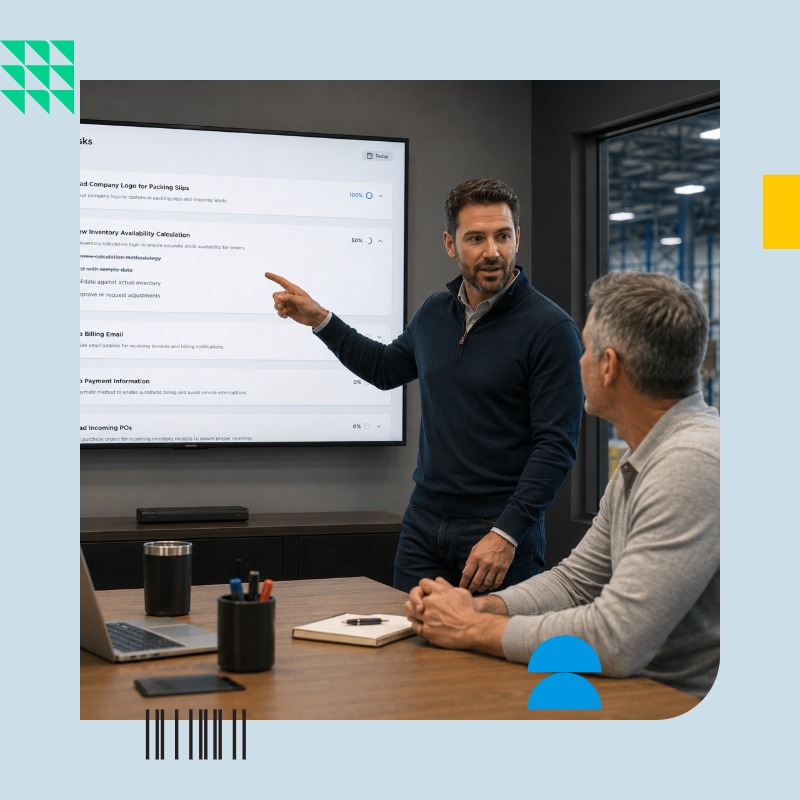
The QBR made sense when it was invented. Pulling operational data was laborious. Formatting it for clients took time. Getting everyone in a room was the only practical way to make sure clients saw what was happening.
So the QBR became the rhythm. Once a quarter: pull the data, build the slides, present the numbers, field the concerns, agree on next steps. Repeat.
The reality that made QBRs necessary is gone. Data is real-time. Visibility is continuous. The information a QBR used to deliver is available to any client with a modern portal at any moment. The meeting hasn’t caught up with the technology.
What the traditional QBR actually costs
The prep alone is significant. A thorough deck for a mid-sized client takes four to eight hours — pulling data from the WMS, formatting it, building narrative, reconciling the numbers that don’t look right before the client sees them.
A dozen clients, four times a year. That’s hundreds of hours of account management time going into a deliverable whose core purpose — informing clients about their performance — could be handled continuously and automatically.
Then the meeting itself. When the QBR is a performance review, clients arrive with a list of concerns they’ve been saving. The 3PL arrives hoping the numbers look good. Both sides spend the first half establishing what happened last quarter. Strategy gets whatever time is left after the defensiveness clears.
The continuous visibility alternative
When clients have real-time access to their data — SLA attainment, inventory accuracy, shipping efficiency — the information function of the QBR is already handled. No surprises in the meeting, because there’s been no information gap since the last one.
Proactive alerts mean anything notable has already been surfaced and addressed before it becomes an agenda item. If an SLA trended down in February, the client knew in February, your team communicated in February, and the fix happened in February. By the quarterly review, it’s historical context, not a live controversy.
What the meeting becomes instead
With performance review already handled by continuous visibility, the quarterly conversation can be what it should’ve been all along: strategic.
What are you launching in Q3, and what does that mean for fulfillment? You’ve been growing DTC — are we sized for what’s coming? There’s a new carrier lane worth looking at — carrier optimization based on order patterns we’ve seen typically yields 8 to 15%. Let’s look at it together.
Those conversations deepen the relationship. They position the 3PL as a partner thinking ahead, not a vendor reporting on the past. And they create the conditions for organic growth — because a client who trusts your strategic judgment expands the relationship when they have something new to figure out.
The format doesn’t disappear — it evolves
This isn’t an argument for killing regular client meetings. It’s an argument for changing what they’re for. The quarterly cadence is fine. The agenda is what needs to change.
With Bright Portal, QBR-ready reporting is always current. There’s no prep because there’s nothing to pull and format — the data is live and the presentation layer is already built. The account team walks in with time to spare and a conversation prepared, not a deck to defend.
That’s a different meeting. One clients actually look forward to. One that ends with decisions about the future instead of arguments about the past.
The QBR isn’t dead. The version that exists to inform clients of things they should’ve known already is. What replaces it is better — and the 3PLs building toward it now will have a significant head start.
When clients have real-time access to their performance data, the quarterly review stops being a status update and becomes a strategy conversation. Bright Portal keeps QBR-ready reporting always current — so your team shows up with a plan, not a deck to defend.