If you’ve been through a traditional LMS rollout, you know what you’re actually signing up for.
First come the industrial engineers. They spend weeks on your floor with clipboards and stopwatches, watching pickers pick and packers pack, measuring every motion for every process for every order type in every aisle configuration. It’s meticulous. It’s expensive. And it makes your workers visibly uncomfortable.
Then you build labor standards. Single-line pick from a floor location: 42 seconds. Batch pick, three-to-five units, zone B: 67 seconds. Every permutation your operation runs gets a number.
Then the change management starts. Engineers underfoot. Workers wondering if they’re next. Supervisors learning a new reporting layer on top of everything else they already manage. Six months later, you’re live, exhausted, over budget, and quietly unsure whether the standards you built still match how your operation actually runs, because it changed during the implementation.
The problem isn’t effort. It’s where you start.
Traditional LMS implementations are expensive not because labor management is hard, but because they start from zero. Every standard built from scratch. Every process studied. Every worker profiled against standards that didn’t exist until you paid to create them.
Then you add a new carrier contract or a new pick flow, and you do pieces of it again.
The WERC publishes benchmark standards that some operations use as a shortcut. The problem: they come from a survey of roughly 200 respondents, not observed operational data. That’s a thin sample to stake a labor program on.
What if the standards were already built?
Not from a survey. Not from a time study you funded. From actual scan data across tens of thousands of workers running the same processes, the same order types, in real warehouses on the same platform.
That’s how Labor Intelligence works. It draws on 60 million tracked labor hours across 5,500+ brands. The benchmarks come from real performance data, broken down to the process level, the order type, the pick method. AI models the relationships between those data points and sets a standard based on how your peers on the platform actually perform, not how 200 survey respondents said they do.
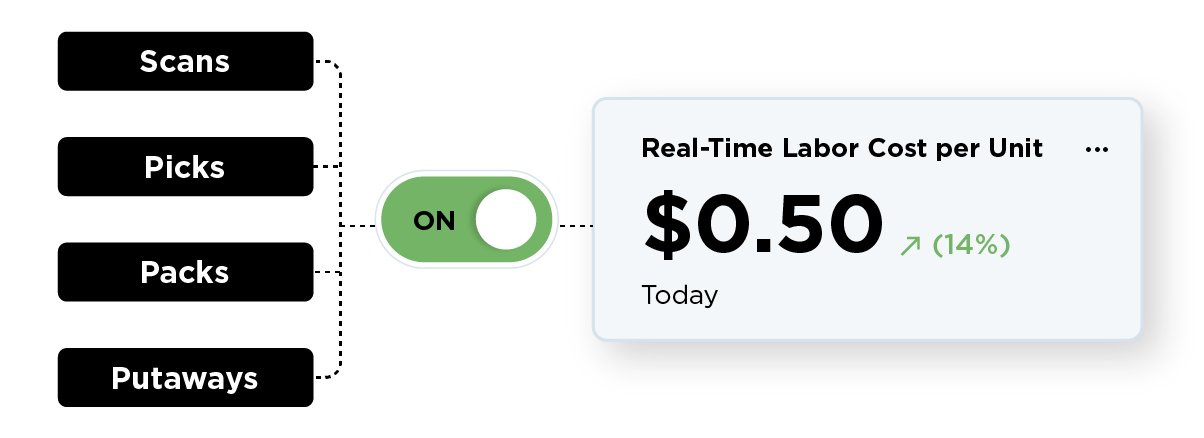
Setup is not a project. You input your average hourly rate and your shift hours. Labor Intelligence is live before your next shift. No engineers. No time studies.
What you get on day one
Labor cost per order. Efficiency benchmarked against the 75th and 90th percentile of your platform peers. Throughput by order type. Utilization by worker. All of it live the moment you turn it on, because the data has been accumulating in your WMS since your first transaction.
When something looks off, you don’t dig through charts. Ask Felix, Deposco’s AI assistant, and it traces the root cause directly: which order type, which process, which worker, how much it’s costing you. The kind of investigation that used to eat a week of analyst time now takes a single question.
If implementation complexity has kept you from pulling the trigger on labor management, the calculus has shifted. Worth a second look.
See your labor costs, throughput, and efficiency benchmarked against platform peers — live before your next shift, no engineers required.