
In the modern supply chain, we often treat Demand, Labor, and Execution as distinct operational phases, each governed by its own leadership, KPIs, and software. The Demand Planners chase forecast accuracy; the Workforce Managers chase utilization rates; and the Logistics Directors chase on-time delivery.
But in the warehouse, these three forces are not distinct. They are a single, volatile continuum.
When viewed in silos, they create friction. When viewed holistically, they create opportunity. The reality of modern order fulfillment is that you cannot optimize one without the others. Demand drives labor, and labor sets the stage for execution.
Get a 1:1 demo of our Supply Chain Intelligence (SCI) solutions, your command and control center for operational excellence.

The three pillars of cost (and chaos)
To understand why the intersection of these forces matters, we have to look at the three biggest cost drivers in fulfillment: Inventory, Shipping, and Labor.
Most organizations try to lower these costs individually, but they are intrinsically linked by the operational “blind spots” between teams.
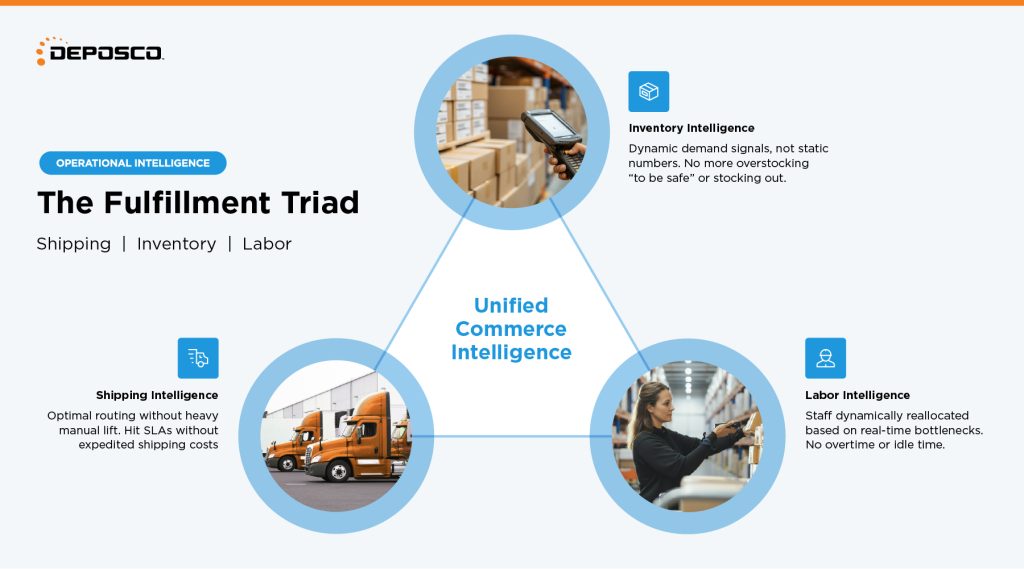 1. Demand & inventory: the trigger
Everything starts with demand. But when demand data is siloed away from the warehouse floor, it becomes a static number rather than a dynamic signal.
- The Silo Effect: If demand spikes and labor isn’t adjusted in real-time, you end up with bottlenecks. Conversely, if demand softens and labor remains high, you bleed money on idle time.
- The Cost Impact: Poor demand visibility leads to reactive inventory management, like overstocking to be “safe” or stocking out and losing revenue.
2. Labor: the capacity engine
Labor is the bridge between what you want to sell (demand) and what you actually ship (execution). Yet, labor is often planned based on historical averages rather than real-time demand signals.
- The Silo Effect: A reactive labor force is always expensive. You are either paying for overtime to catch up or paying for standing around.
- The Cost Impact: This directly increases labor costs, which remain the highest operating cost in today’s warehouses, taking up 50 to 70% of a company’s warehousing budget.
3. Execution and shipping: the result
Supply chain execution is where the rubber meets the road—picking, packing, and shipping. But execution is entirely dependent on the capacity set by labor and the accuracy of inventory.
- The Silo Effect: If labor is misaligned with demand, execution falters. Packages miss the cutoff time. To save the customer relationship, you upgrade the shipping method.
- The Cost Impact: This bloats shipping costs. You end up paying premium rates to mask upstream inefficiencies.
The connectivity crisis
The problem isn’t that we lack data; it’s that the data lacks context.
- The Sales VP sees a revenue opportunity.
- The HR Director sees a staffing roster.
- The Warehouse Manager sees a pile of boxes.
Without a unifying layer of Operational Intelligence, these leaders are effectively speaking different languages. They are optimizing their own islands while the bridge between them burns.
The solution: contextual operational intelligence
To thrive in an omnichannel world, we must stop viewing demand, labor, and execution as linear steps and start viewing them as a feedback loop.
This is the role of true Operational Intelligence: synchronization and orchestration.
It connects the dots to answer the complex questions that silos cannot:
- “Based on the intake of orders in the last hour (demand), do I need to shift pickers to packing stations (labor) to meet the carrier pickup time (execution)?”
- “If I move inventory to a forward pick location now (inventory), how much walking time will I save my staff (labor), and will that let me get these orders out today (shipping)?”
When AI-powered supply chain intelligence unifies the triad in <90 days, what could you achieve? Book a personalized ROI assessment with one of our experts today.

AI breaks the silos that inhibit margins
Modern fulfillment isn’t about working harder; it’s about decision latency. How fast can you translate a change in demand into a change in labor strategy?
When you unify your view of these forces, the math changes:
- Demand becomes actionable: Forecasts directly inform staffing schedules.
- Labor becomes agile: Staff can be dynamically reallocated based on real-time bottlenecks.
- Execution becomes predictable: Shipping costs drop because you are hitting SLAs without expedited measures.
The companies that win tomorrow won’t just have better software; they will have better vision. They will understand that you cannot fix shipping costs by negotiating rates, and that you cannot fix labor costs by hiring faster. You solve both by respecting the triad’s intersection. That’s Deposco’s AI-powered commerce intelligence.