
For a 3PL operations leader, the cost of the wrong client portal isn’t paid in the vendor invoice. It’s paid in the constant flow of client questions clogging up your team, the manual data pulls before every QBR, and the quiet client conversations that eventually become churn — at an industry average of 40% per year.
If ShipHero is on your shortlist, you’re past the point where clients accept weekly spreadsheet updates. The next question is whether the portal you pick keeps your team routing every request, or whether it lets clients act on what they see, within the guardrails you set, so your operations team can focus on growth instead of triage.
The 3PL client portal market has shifted. Real-time visibility, AI-assisted client interaction, and collaborative demand planning (capabilities that used to live only inside enterprise logistics platforms) are now available without a heavy implementation project. The question isn’t whether to upgrade beyond visibility-only portals. It’s which portal lets your 3PL grow client relationships instead of just supporting them.
3PL operations, technology, and CX leaders evaluating ShipHero alternatives are usually dealing with:
- Portals that currently show clients data but don’t allow them to act on it need to be replaced by portals built for direct client self-service within 3PL-controlled guardrails.
- Manual QBR prep work, which requires pulling reports for every client meeting, should be replaced by dashboards that are always current, always on-brand, and ready for QBR conversations.
- Instead of using overlay portals that sync data from a separate WMS, the focus is shifting to natively integrated portals where client data, warehouse operations, billing, and planning share one source of truth.
- The client experience needs to evolve to match what shippers now expect, moving towards collaborative planning tools and AI-assisted interaction that make your 3PL genuinely harder to leave.
In this post, you’ll find 5 ShipHero alternatives to help you choose the best 3PL client portal for your logistics business:
- Deposco Bright Portal — Best for 3PLs that want clients acting on their data, not just viewing it
- Octup (Octopus) — Best for 3PLs adding a portal overlay on top of existing WMS and ERP systems
- Logiwa 4PL Client Portal — Best for 3PLs needing client visibility with no-code workflow configuration
- Made4Net Synapse Anywhere — Best for 3PLs running Made4Net WMS that want a client portal alongside it
- Extensiv Hub — Best for 3PLs operating multi-location warehouse networks with billing automation needs
Ready to see how Bright Portal can improve your client experience?
1. Deposco Bright Portal — Best for 3PLs that want clients acting on their data, not just viewing it
BEST FOR: 3PLs of any size looking for a natively integrated 3PL client portal that combines real-time visibility, actionable client self-service, collaborative demand planning, and white-label branding in a single platform, with no separate implementation project.
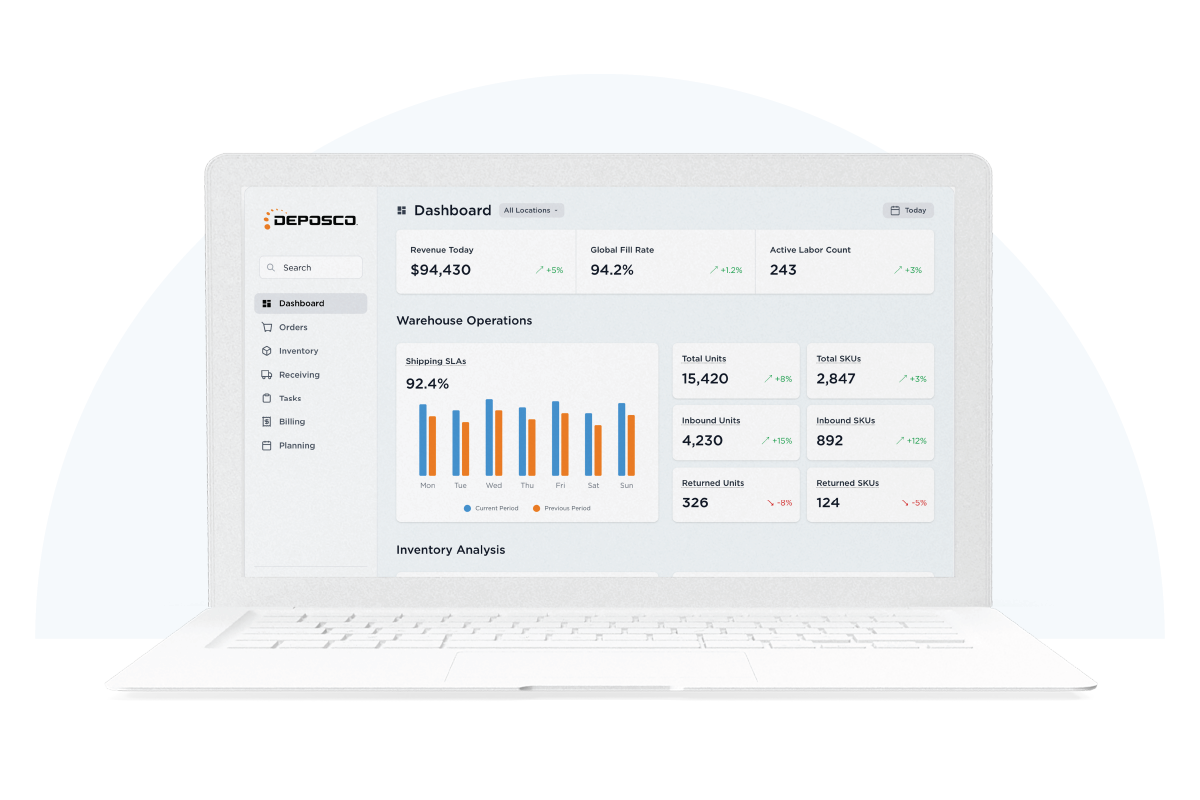
Launched in April 2026, Bright Portal is built natively into the Deposco platform. Client-facing data, warehouse operations, billing, order management, and demand planning are connected at the source rather than stitched together after the fact. For 3PLs that want a client experience their competitors can’t easily replicate, Bright Portal was designed for exactly that buyer.
Key feature #1: Actionable self-service with an AI client assistant
Gap: Most 3PL client portals are read-only. Clients can see inventory levels and order status, but every change, cancellation, or proactive action routes back through the 3PL operations team. As the client base grows, the volume of routing requests grows with it, and the operations team spends its time on triage instead of strategic work.
How: Bright Portal is built around action, not just visibility. Clients act directly on their data within guardrails the 3PL controls, eliminating the back-and-forth that clogs operational throughput. An AI client assistant lets users query data, get answers, and trigger actions in natural language, without needing to contact 3PL support.
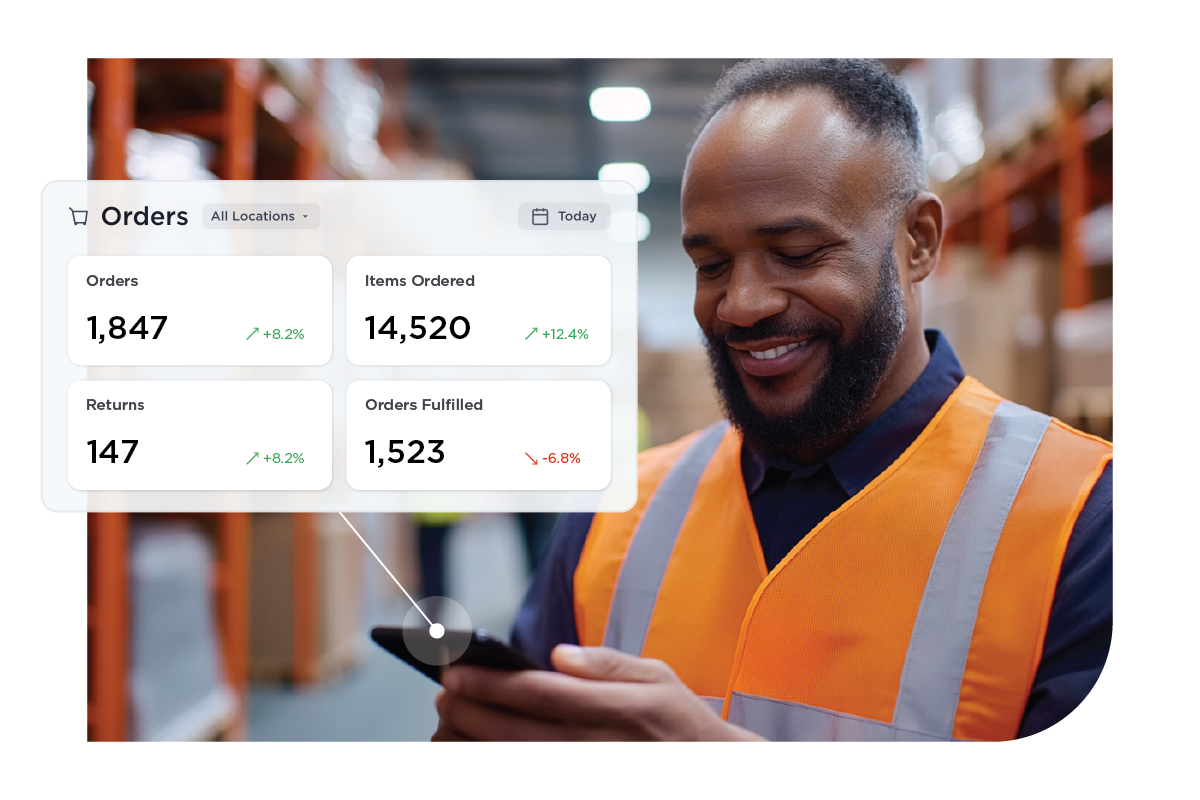
Scenario: A consumer goods brand needs to reroute a fast-moving SKU between two of their 3PL’s DCs ahead of a promotion. Instead of emailing the 3PL’s account manager and waiting for confirmation, they request the move directly in Bright Portal, the AI assistant confirms the inventory positions, and the action executes inside the guardrails the 3PL has pre-configured. The 3PL operations team sees the activity in the dashboard and only intervenes if something falls outside policy.
Key feature #2: Native platform integration, not an overlay
Gap: Overlay portals look fine in a demo. At 18 months in, the cost of an overlay shows up everywhere: data sync lag, broken integrations after WMS updates, client-facing dashboards that drift from operational reality, and an architectural seam that every IT release has to cross.
How: Bright Portal is built natively into the Deposco platform. Client views, warehouse operations, billing workflows, and demand planning all read from the same source of truth. There is no sync layer to break, no separate system to maintain, and no architectural seam between what the client sees and what the warehouse is doing.
Scenario: A 3PL adds 20 new SKUs for a growing client on a Friday afternoon. By Monday morning, those SKUs are visible in the client’s portal view, the warehouse team is receiving them through the same WMS, and billing is configured to charge the right rate, all without anyone reconciling data between systems.
Key feature #3: Collaborative forecasting and demand planning with clients
Gap: Most 3PL client portals stop at visibility. They show clients what happened. They don’t help the 3PL and the client plan together for what’s coming next, which means the QBR conversation stays tactical and the 3PL stays in the cost-center bucket in the client’s mind.
How: Bright Portal includes a collaborative planning toolset powered by Deposco’s demand planning algorithms. The 3PL and client share a view of inventory targets, demand signals, promotional plans, and seasonality. The 3PL can feed that planning data into warehouse capacity and labor planning. Routine check-ins become strategic conversations, and the client experiences the 3PL as a planning partner rather than a fulfillment vendor.
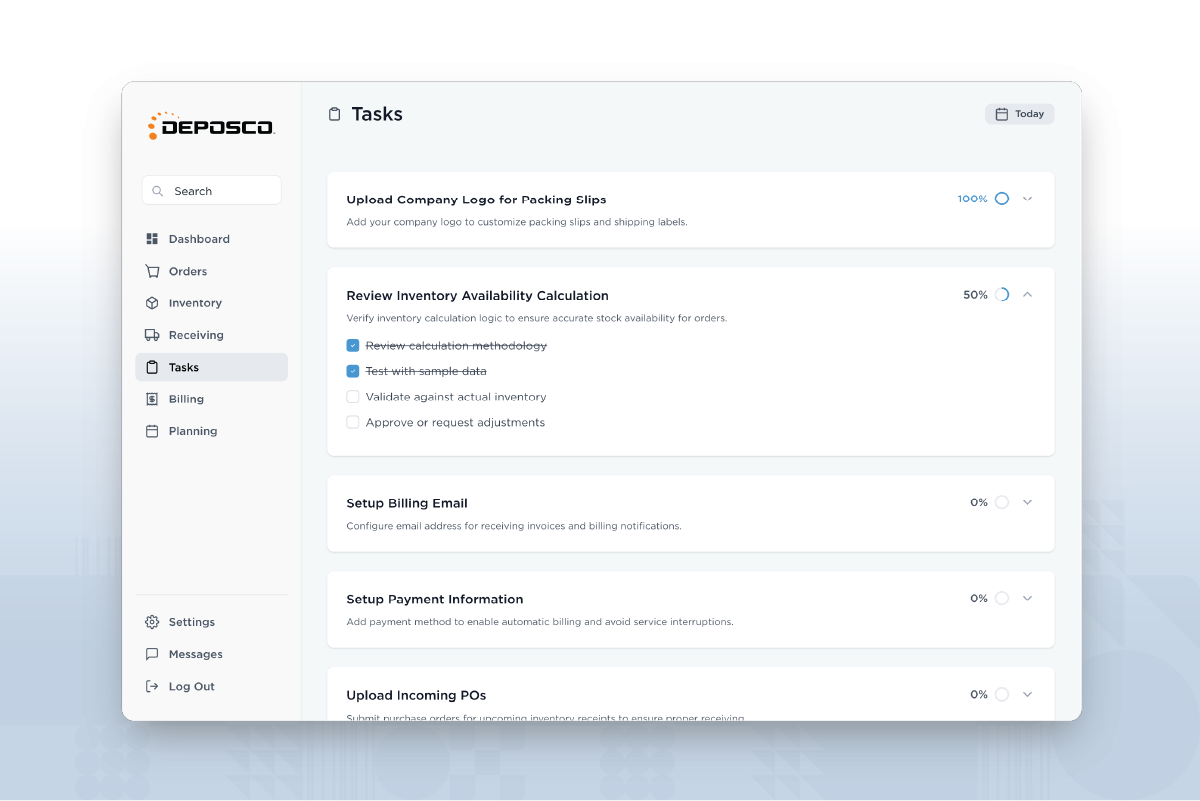
Scenario: A Health & Wellness brand and their 3PL sit down for the quarterly business review. Instead of the 3PL presenting last quarter’s metrics from a slide deck, both teams pull up the collaborative planning view in Bright Portal. They walk through next quarter’s promotion calendar, agree on safety stock positions across the network, and align on labor requirements. The 3PL leaves the conversation with a plan the client co-built — and a switching cost the client now has to weigh against any RFP.
Key feature #4: QBR-ready dashboards and white-label branding with no implementation project
Gap: Manual QBR prep eats 3PL account-management capacity. Custom reports get built every quarter, pulled from disconnected systems, and rebranded for each client. Portals that promise to fix this usually require a multi-month implementation, IT involvement, and ongoing maintenance to keep branded views and permission models current.
How: Bright Portal dashboards are always current and always on-brand. SLA performance, shipping efficiency, and inventory accuracy surface in the client’s language without a manual data pull. The portal is fully white-labeled with the 3PL’s logo, colors, and domain. Permissions, client views, and onboarding workflows are configurable directly by the 3PL team, with no development resources. For existing Deposco customers, Bright Portal is available immediately with no separate implementation engagement.
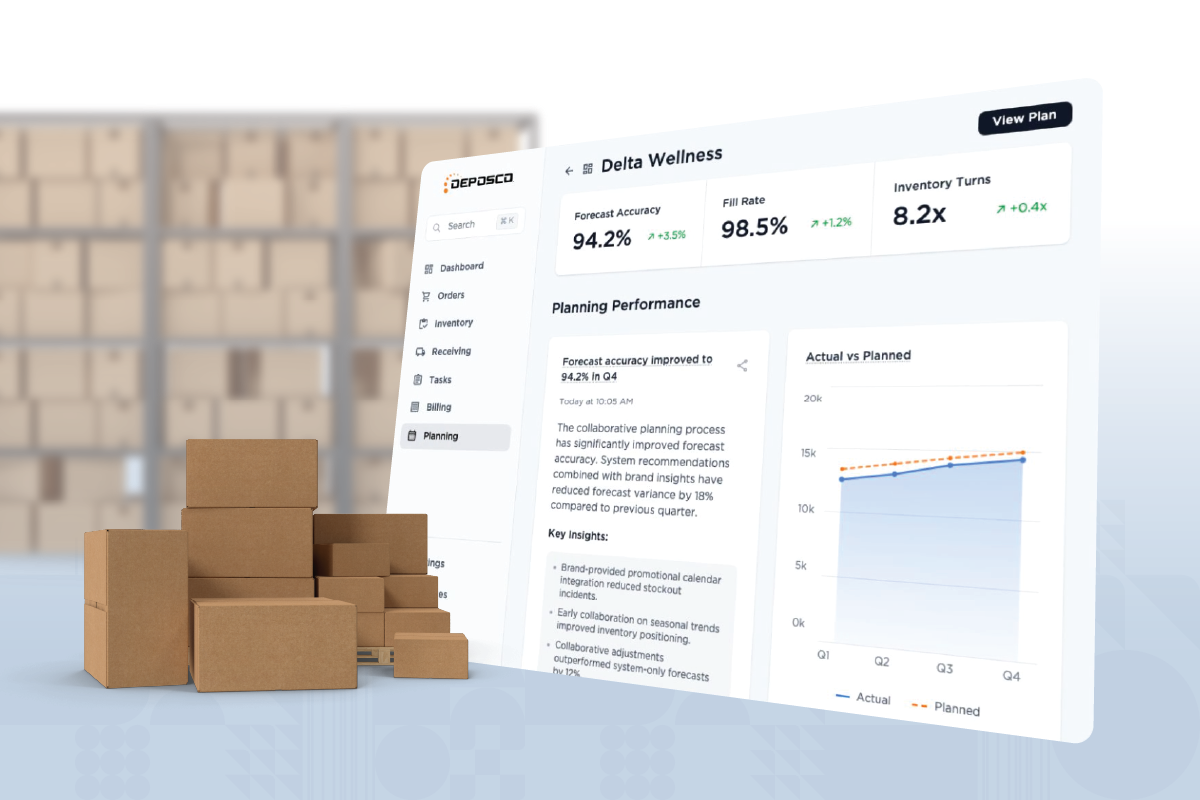
Scenario: A 3PL’s account manager prepares for QBRs across 30 clients in a single week. Instead of building 30 custom decks, she walks into each conversation with the client’s own portal pulled up: their inventory positions, their SLA performance, their cost-to-serve trends, all branded with the 3PL’s logo. The conversation moves from “here’s what happened” to “here’s what we should do next quarter” — for every client, every quarter, with no manual prep behind it.
The only 3PL client portal natively built into your WMS — actionable, white-labeled, and ready now without an implementation project.
2. Octup (Octopus) — Best for 3PLs adding a portal overlay on top of existing WMS and ERP systems
Octup is an overlay platform that surfaces analytics and billing data from a 3PL’s existing WMS and ERP systems through configurable client-facing dashboards. AI-assisted search lets users query operational information without building custom reports.
Features & capabilities
- Branded client dashboards for order activity and performance data
- AI-assisted search and query tools for reporting and operational data exploration
- Automated billing capture with itemized charge tracking
- Overlay architecture that runs alongside existing enterprise systems rather than replacing them
What to watch: The overlay model is Octup’s defining trade-off. Clients can view data surfaced through the Octup layer, but acting on that data still requires going back to the underlying WMS, which can create a workflow split for clients expecting a single environment. 3PLs evaluating Octup should weigh the implementation simplicity of the overlay approach against the workflow fragmentation it can introduce at scale.
3. Logiwa 4PL Client Portal — Best for 3PLs needing client visibility with no-code workflow configuration
Logiwa’s 4PL portal offers 3PL clients visibility into order activity, inventory positions, and billing records. The platform includes no-code workflow configuration for fulfillment processes alongside recurring billing automation.
Features & capabilities
- Order and inventory visibility scoped to each client account
- No-code workflow setup for fulfillment operations
- Built-in billing and charge management for recurring activities
- Reporting layer covering core operational data
What to watch: Logiwa’s portal has historically leaned more toward visibility than direct client action. Clients can see their data, but their ability to act on it from within the portal itself has been more limited. 3PLs evaluating Logiwa for client-facing use cases should clarify the current actionability scope alongside the operational and billing capabilities, and confirm the partner’s continued investment in what clients can do within the platform.
4. Made4Net Synapse Anywhere — Best for 3PLs running Made4Net WMS that want a client portal alongside it
Made4Net provides a web-based client portal that runs alongside its core warehouse management system. Clients can review stock positions, shipment activity, and transactions tied to billing events.
Features & capabilities
- Stock-level and shipment-status visibility for client accounts
- Automated billing workflows linked to warehouse activity data
- Support for light assembly, labeling, and value-added services
- Integration with the broader Made4Net WMS platform
What to watch: Made4Net positions its operational capabilities ahead of its portal experience. 3PLs whose primary evaluation criterion is the client-facing portal — rather than the underlying WMS — may find the portal feature set less differentiated relative to alternatives that have recently invested specifically in the client experience layer.
5. Extensiv Hub — Best for 3PLs operating multi-location warehouse networks with billing automation needs
Extensiv Hub provides a client portal for data access and operational oversight across multi-location warehouse environments. It links order information to billing and invoicing workflows.
Features & capabilities
- Inventory and order detail views across multiple warehouse sites
- Automated billing tied to warehouse activity data
- Central dashboard for monitoring network-wide operations
- Invoicing and charge reconciliation tooling
What to watch: Extensiv Hub’s portal capabilities have drawn mixed feedback in recent third-party evaluations. 3PLs whose competitive position depends heavily on client-facing experience — particularly in active deal environments — should evaluate the current feature set carefully against their specific portal expectations.
Why Deposco Bright Portal stands out among ShipHero alternatives
Each platform on this list has a defensible use case, but they don’t all solve the same problem. Octup keeps the implementation simple as an overlay. Logiwa and Extensiv Hub center on visibility and billing automation. Made4Net’s portal sits inside a broader WMS investment.
Where Bright Portal stands apart for 3PLs, particularly the operations and CX leaders trying to turn client experience into a retention moat, is the combination of four things in one platform:
- Actionable self-service with an AI client assistant, so clients act on their data within guardrails the 3PL sets, instead of routing every request through your team
- Native platform integration that connects client-facing views, warehouse operations, billing, and demand planning at the source rather than across a sync layer
- Collaborative demand planning shared with clients, turning QBRs into strategic conversations and creating real switching costs
- White-label branding and no implementation project for existing Deposco customers, so Bright Portal goes live without IT involvement or a separate engagement
If you’re trying to close the gap between what your clients now expect and what your current portal delivers — and you’d rather not bolt on another overlay to do it — Bright Portal is built for exactly that buyer.
See how Bright Portal combines native integration, self-service action, and AI-assisted planning in one platform.
Vendor capabilities described in this article reflect publicly available information and vendor documentation as of May 2026. Capabilities, features, and product scope vary by tier, deployment model, and customer size. Confirm current details directly with each vendor. This article is for informational purposes and does not constitute a vendor endorsement.