I’ve spent 25 years marketing supply chain software. In that time I’ve watched the same failure hit real companies more times than I can count, and it almost never looks like a failure while it’s happening.
A brand does something right. Demand shows up. Then the thing nobody was watching gives way.
So this year we built a brand and let it happen on purpose.
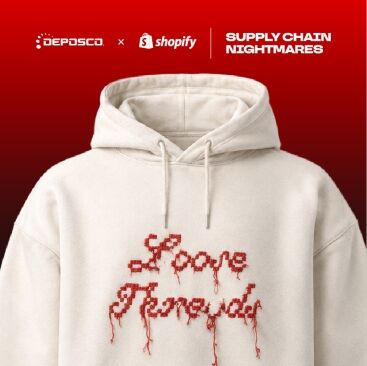
Loose Threads is a fictional streetwear label. Four people, one heavyweight hoodie, two years of careful work. Its fall drop went viral when a DJ wore the hoodie on stage in Atlanta. It sold more units in 48 hours than in the previous fourteen months combined.
Six weeks later it was out of business.
Watch Loose Threads unravel day by day, then see the version where the hoodies actually ship.
Nothing crashed
Here’s the part most cautionary tales get wrong.
The storefront never failed. Traffic rose fortyfold in eight hours and the commerce layer absorbed all of it. Pages loaded. Checkout cleared. POS kept selling. Customer profiles stayed unified across every channel. Commerce did exactly what commerce is built to do — it captured demand without dropping any of it.
What failed was everything after “Add to Cart.”
Loose Threads had four sales channels working from four different inventory numbers. The website knew one figure. The marketplace synced nightly. Retail partners had been allocated from a spreadsheet. The warehouse counted the shelf. On a normal Tuesday that’s a rounding error you catch in a weekly reconciliation.
The drop was not a normal Tuesday. By the end of that week the brand had taken orders for 2,380 units of a hoodie it had 1,800 of. A 32% oversell. 580 orders with nothing behind them.
No alert fired. No dashboard turned red. Every system behaved correctly according to the number it had been given — and all of those numbers pointed at the same hoodies. The founders found out from the warehouse, on a Monday, when the picks came back short.
The second failure is worse than the first
Loose Threads had inventory it never shipped. 180 units in a retail partner’s stockroom, in a city where hundreds of orders were waiting. A container that cleared customs on Tuesday. Returned stock in a bin by the receiving door.
None of it could be reached. Order capture was excellent. Routing was a person with a laptop. When the one designated fulfillment location ran out, the queue simply stopped — not because the goods were gone, but because nothing in the stack knew to ask a second question.
Then 580 cancellation emails went out. The customer doesn’t care about a sync interval. What the customer reads is: you took my money for something you didn’t have.
By day sixteen the comments stopped saying “delayed” and started saying “scam.” Nobody using that word was lying. From the outside, a brand that charges you and doesn’t ship is indistinguishable from one that never intended to. You never get to explain the sync interval. Only the result is public, and the result looks like dishonesty.
Why this year is unforgiving
Our own platform data says the margin for error is thinner than usual. Across 90 million shipments on the Deposco network, peak GMV is growing 18% while order volume recovers just 5% — units are rising roughly three times faster than orders. Almost every peak labor plan in this industry is still built on order counts.
At the same time, weeks of inventory have fallen 26% since April 2025 while out-of-stock rates have climbed 12%.
More units, leaner stock, less room to recover. That’s the environment between now and January.
What actually prevents it
Commerce and fulfillment are two halves of the same promise.
The front end makes the sale possible. The operational layer underneath makes it deliverable. Neither is sufficient alone, and the seam between them is where brands break — because a great front end never warns you. It hides the gap until volume finds it, and volume finds it on the day you have the most to lose.
Psycho Bunny cut short ships from 10% of orders to 1%, then recovered a Black Friday mid-flight by opening store inventory to fulfillment. Feature eliminated overselling and chargebacks outright. DIME Beauty raised daily picking and shipping capacity 232% while holding inventory accuracy above 99.5%.
Same commerce platform. Different ending — because they built the layer Loose Threads never did.
Why we told it as a story
I could have written a white paper about inventory visibility. You wouldn’t have read it, and I wouldn’t blame you.
Supply chain marketing is notoriously dry. We’ve spent several years trying to break that mold, and what keeps working is a story where the stakes are legible — where you can picture the founder opening the laptop and reading the email.
Loose Threads is invented. The sequence that kills it is one I’ve watched play out for two and a half decades at companies with real names.