Why AI-powered commerce intelligence is where supply chain transformation actually happens.
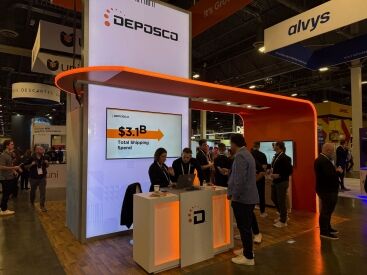
I just got back from Manifest 2026 in Las Vegas—three days of conversations, demos, and keynotes focused on the future of supply chain and logistics technology. I came away energized by the people, genuinely impressed by the breadth of innovation on display, and… a little concerned about what “AI” has come to mean in our industry.
Let me be direct: AI was everywhere at Manifest. On banners. In booth names. Embedded in every product pitch. And yet—when the conversations got specific about outcomes, ROI, and operational impact—the room often got quiet. The promises were enormous. The production results were thin.
That gap is not an accident. It’s a structural problem. And understanding why it exists is the key to understanding where AI in the supply chain is actually going.
The AI theater problem
Walk the Manifest floor and you’ll encounter a particular kind of AI demo: clean dashboards, impressive visualizations, and a narrative arc that goes something like this—“our AI analyzes your data, surfaces insights, and recommends the optimal action.”
It looks great. But there’s a question worth asking: whose data is it analyzing? And is it actually connected to the systems where work gets done?
The uncomfortable reality is that most enterprise AI today is built on top of fragmented data pipelines, exported spreadsheets, and best-effort integrations between systems that were never designed to talk to each other.
The AI is smart. The data plumbing is not.
And no matter how sophisticated the model, garbage in still means garbage out—just garbage out with a more polished interface.
This is AI theater—and it was well-represented at Manifest 2026.
What AI actually needs to work in production
Real AI results require a Supply Chain Intelligence model that sees your shipping costs rise 12% and knows whether that’s a problem or the expected result of a promotion you just ran. They require recommendations grounded in operational reality—not just plausible-sounding outputs that can’t be traced back to how your business actually runs. And they require more than your own historical data: your past tells you what happened, but network-level data tells you what’s possible—benchmarked against thousands of businesses operating in the same conditions.
SCI extends WERC’s foundation with real-time intelligence.

Why platform apps win: the synthesized data advantage
This is why I believe the real AI results in supply chain are going to come from platform-native applications—not from AI features bolted onto point solutions or AI tools that sit outside the systems of record.
The data is already there
Platform apps like Deposco sit at the intersection of operational execution and enterprise data. Every pick, pack, and ship creates data. Every inventory movement creates data. Every carrier interaction creates data. And because that data lives in one platform—not scattered across a dozen integrations—it can be synthesized in ways that no point solution can replicate.
The network makes it smarter
When we launched Supply Chain Intelligence at Manifest, we were making exactly this bet. The Deposco platform processes over $100B in GMV annually across 4,500+ brands and 3PLs. That’s not a feature—that’s a data network. And that network is what makes it possible for our AI to do something that isolated tools simply cannot: connect the dots between your operational execution and your enterprise profitability in real time.
The dots connect automatically
The example I keep coming back to: one of our early SCI customers discovered that their best-selling SKU—representing 18% of revenue—was losing money on every single order. Operations knew the SKU required special handling. Finance knew the margins looked good on paper. But nobody had connected the labor cost, the carrying cost, the expedited shipping cost, and the actual order-level profitability into a single view. SCI did that automatically. Not as a one-time analysis. As a living, operational intelligence layer.
It closes the loop between insight and action
That’s what synthesized data makes possible. And you can’t get there by connecting more point solutions. You get there by running on a platform where the data is already unified.
The evolution to agentic enterprise: AI that actually does the work
Here’s the bigger shift I see coming—and it’s one I think Manifest was just beginning to grapple with.
Enterprise software has spent decades optimizing for decision support: better dashboards, smarter reports, faster analytics. The implicit assumption is that a human sits between the insight and the action. The AI surfaces the recommendation. The human decides. The system executes.
Executing, not just informing
That model is changing. We’re moving from enterprise software that informs decisions to agentic enterprise solutions that execute work. The AI doesn’t just recommend that you adjust your replenishment order. It adjusts it. The AI doesn’t just flag that a promotion is destroying margin on a specific SKU category. It modifies the promotion parameters in real time.
Felix: Deposco’s team of agents
This is what Felix, Deposco’s multi-agent AI system, is designed to do. Not to be a business intelligence layer that sits on top of operations—but to be an active participant in operations. When a flash sale drives order volume up 40%, Felix doesn’t wait for a monthly business review to surface the margin impact. It calculates in real time that those orders required 2.3x more pick time, pushed shifts into overtime, and destroyed margin on 67% of transactions—and it delivers that insight in time to actually change course.
The move to agentic enterprise is not just about faster insights. It’s about compressing the decision-action cycle to the point where AI isn’t supporting the process—it’s running it. And that shift only works when the AI has context, trust, and scale.
What I’m telling operators who were at Manifest 2026
If you were there, and you’re now sorting through a stack of vendor decks with “AI-powered” on every slide, here’s the filter I’d apply:
Ask where the data lives. If the AI requires you to export, integrate, or sync data from your systems of record into a separate analytics environment, that’s a structural limitation—not a technical detail. The latency between data and action is where AI value goes to die.
Ask about network effects. Does the AI get smarter from operating across multiple customers? Is the model trained on industry-level data, or just yours? The best platform-native AI compounds in value as the network grows—that’s a defensible advantage that AI point solutions can’t replicate.
Ask who acts on the recommendation. If the answer is always “a human reviews it and decides,” you’re buying a better BI dashboard, not an agentic capability. Ask how the AI closes the loop—and what it would take for it to act autonomously on well-defined, high-confidence decisions.
The real AI era is just starting
I want to be clear: I’m not pessimistic about AI in supply chain. Quite the opposite. I think we’re at the beginning of a genuine transformation—one that will make the last decade of supply chain software innovation look modest by comparison.
But the transformation will be led by platforms, not point solutions. By companies that have earned the right to call their AI “trusted” because it’s built on intelligence data that actually reflects how their customers operate. By agentic systems that close the loop between insight and action, not just ones that surface another dashboard.
Manifest confirmed something I’ve believed for a while: AI is not a feature. It’s a foundation. And the companies building on the right foundation—with real data, real context, and real operational integration—are the ones who will deliver real results.
Everything else is theater. And Las Vegas already has enough of that.
Todd Craig is Chief Marketing Officer at Deposco, the leading cloud-native WMS and OMS platform for brands and 3PLs. Deposco’s Supply Chain Intelligence suite connects operational execution to enterprise profitability across 4,500+ customers and $100B+ in processed GMV. To learn more, request a demo.