
Every supply chain software vendor now claims to “have AI.” It has become the checkbox that gets you through the door. But most of what’s sold as AI is either basic automation wearing a new label, a bolt-on feature stitched to legacy architecture, or a generic tool that requires your team to do all the heavy lifting.
This guide will help you decode what vendors actually mean when they throw around AI terminology, give you the questions that separate substance from spin, and what genuinely intelligent supply chain technology looks like in practice.
Transformational AI is a requirement, not an option
AI doesn’t fix a broken supply chain tech stack; it exposes it. Layering AI onto fragmented systems without a unified data foundation shows up as stockouts, shipping cost overruns, labor inefficiency, and missed service commitments. Not as abstract model errors in a dashboard—as real money walking out the door. And that’s before you consider the wasted money on snake oil that was more poison than cure-all.
The AI terms you keep hearing vs. what they mean
Before you can challenge vendor claims, you need a shared vocabulary. Here’s what the most common terms actually mean and what to watch for.
“We have AI” (aka “AI-ish”)
This is the broadest claim and often the most nebulous. It means AI is present somewhere in the product, but that could range from genuine real-time intelligence woven throughout the platform to basic pattern detection or a chatbot bolted onto a legacy workflow. The variance is enormous. When you hear this, your next question should be: “Where, specifically, doing what, and how?”
“AI-native”
This should mean the product was architected around data, learning, and feedback loops by the same data scientists who built the platform—not retrofitted. But it’s often claimed without substance. The test: Can the partner show you how their system learns from operational data over time? Can they demonstrate the feedback loop? Can they tell you what causal datasets are reinforcing the model? “AI-native” without operational history and usable data is inherently suspect. You can’t learn from what you don’t have.
Machine learning (ML)
Models that learn patterns from historical and operational data. Sounds impressive, but the value depends entirely on data quality and context. An ML model trained on siloed, incomplete, or stale data will produce siloed, incomplete, or stale recommendations. Ask: What data is the model trained on? How fresh is it? How does it account for your specific operational constraints? How much emphasis does it put on recency? Don’t accept magic numbers.
Generative AI (GenAI)
This is the hot category, genuinely useful for summarization, creating data narratives, and guided workflows. AI that draws from general intelligence is not automatically good at operational optimization because it lacks the context uniquely helpful to your business. It can tell you a story about your data. But it can’t necessarily tell you which truck to load first, or how to rebalance inventory across your network, since it has not been trained on your specific internal supply chain data.
LLMs are all the rage, but they are a tool for generating human language based on inputs. Unless they are tuned for the task at hand, and fed the right data (see: Machine Learning above), you get a really impressive parrot. Different tool, different job.
Rules and automation (macros) disguised as AI
Deterministic “if/then” workflows are valuable. They’re just not learning systems. If a vendor can’t explain what the system learns versus what it executes, you’re probably looking at automation with a marketing upgrade.
Decision intelligence / prescriptive AI
A system that recommends actions and ideally explains why. This is the meaningful end of the spectrum. But verify: Does it actually prescribe actions, or just surface dashboards and leave the decision to you? Can it tell you which actions matter most right now? It is important to differentiate from predictive. Predictive without Prescriptive leaves you asking: so, what’s that mean? That’s your hint.
The bottom line: If a vendor can’t explain the “how”—data to model to recommendation to feedback loop—you’re likely hearing branding, not capability.
How to spot AI spin over substance
Analysts are increasingly calling out “AI washing” behaviors—vendors rebranding existing products without substance. You don’t need to be anti-AI to ask hard questions. You need to be pro-outcomes.
Here are four questions that separate real capability from good marketing. These are crucial discovery questions if the options seem overwhelming, or if you’re unsure about the ROI of AI supply chain software.
“What data are you using, and how do you ensure it’s complete, labeled, and contextual?”
AI is only as good as the data feeding it. If a potential partner can’t clearly explain where their models get data, how that data is unified across your operation, and how they handle gaps or inconsistencies, their AI claims are built on sand. Real supply chain intelligence requires contextual operational data—orders, inventory, labor, shipping—in one place, not scattered across siloed systems.
“Is this a unified platform or stitched-together acquisitions?”
Many “comprehensive” solutions are actually Frankensteined technology—multiple acquired products with different codebases, different data models, and integration points that leak. When AI sits on top of that fragmentation, it’s optimizing incomplete pictures. Things will crack under pressure. Ask to see the architecture. Ask how long it takes to bring on a new integration. Ask what happens when data from one module needs to inform another.
“Show me a recommendation and walk me backward—why that action, why now, what signal changed, and which fixes should I tackle first?”
This is the transparency test. Real decision intelligence doesn’t just spit out answers; it shows its work. If a partner can’t explain the logic behind a recommendation, you have no way to trust their system—or to know when the model is wrong. And critically: can the system prioritize? Telling you 10 things are broken isn’t helpful. Telling you which one to fix first, ranked by impact and confidence, is.
“What were the timelines and measurable outcomes in your last five go-lives?”
Time-to-value matters. “Show me the money.” If a vendor can’t give you specific numbers—accuracy lift, labor productivity gains, shipping cost reductions, go-live timelines—from recent implementations, you’re their experiment, not their customer. Ask for references. Ask for case studies. Ask what “success” looked like in operations similar to yours.
Watch for: recommendations that ignore reality. If an AI system suggests actions that ignore labor constraints, carrier cutoff times, inventory policies, or customer commitments, you’re looking at AI theater—impressive demos that fall apart when you deviate from script or, worse, in production. Real intelligence operates within your operational reality, not around it.
Where AI actually delivers: the maturity ladder
Not all AI capabilities are equal. Use this framework to map what partners offer and to push them to be specific about where their technology sits.
Level 1: Descriptive — “What happened?”
Visibility, exception reporting, root-cause signals. This is table stakes. Necessary but not sufficient. Most dashboards live here.
Level 2: Predictive — “What will happen?”
Forecasting, ETA risk assessment, capacity risk identification. More valuable, but still leaves the decision to you.
Level 3: Prescriptive — “What should you do?”
Specific recommendations: reroute these orders, rebalance this inventory, change this carrier mix. This is where AI starts earning its keep.
Level 4: Prioritized — “What should you do FIRST?”
This is the layer most providers skip. Stack-ranked actions based on impact, confidence, and operational constraints. Not just “here are your problems” but “here’s the order in which to solve them.” This is where real operational value lives.
A note on “AI-native” claims: It’s easier to credibly claim AI-native in planning and intelligence domains; forecasting, benchmarking, decision engines are inherently model-driven. Claims of “AI-native WMS” often reduce to point optimizations. Be especially skeptical there, and ask them to specify exactly where their AI operates on the maturity ladder.
True AI-powered commerce intelligence ‘shows its work’
When AI supply chain intelligence is done right, it’s not a feature; it’s an operating system that delivers helpful context unique to your business. It’s built and supported by a long-term partner who’s dedicated to building predictable outcomes that are trustworthy, and can scale seamlessly within the rules of the enterprise. Here’s what to look for in a partner who’s serious:
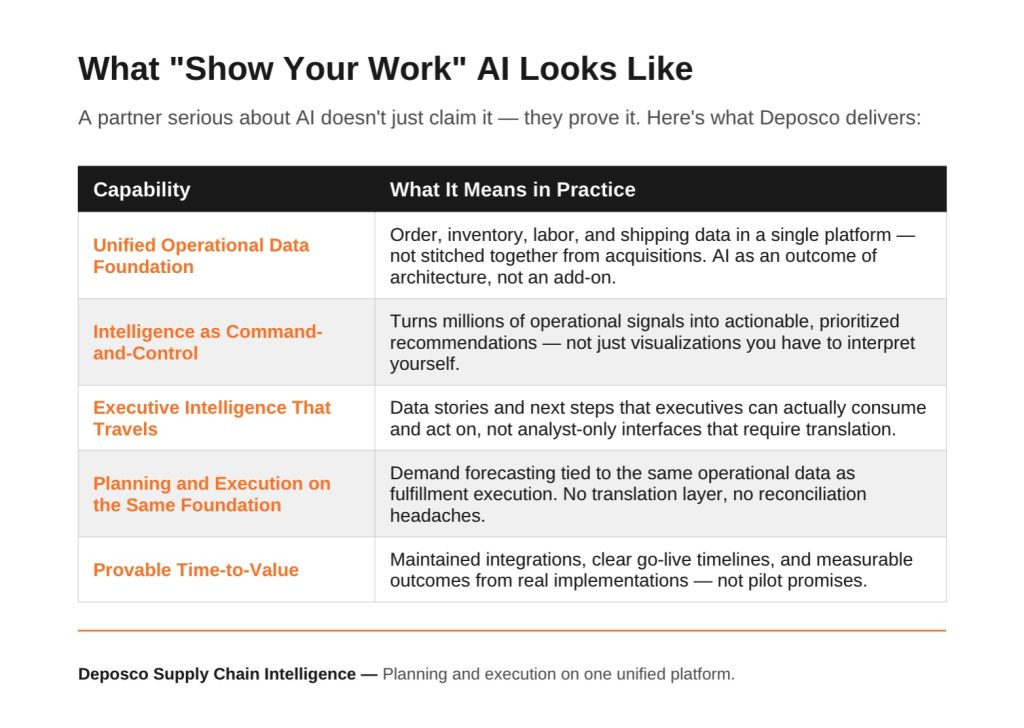
This is the approach Deposco takes with our Supply Chain Intelligence platform: unified data across labor, inventory, and shipping; transparent decision logic; and outcomes you can verify. Not a bolt-on to legacy architecture. Not a third-party tool you have to configure yourself.
A true AI-powered commerce intelligence platform built to surface hidden costs, bottlenecks, and opportunities across your entire operation.
Schedule a personalized demo of our intelligence solutions to see game-changing outcomes others can’t deliver.
Your demo checklist
Bring these 12 questions to every demo. Don’t apologize for asking hard questions. The right partner will show you “the how” of their AI-powered supply chain solutions.
- What specific data does your AI use, and where does it come from? Is it static or a feed? Can it talk to your executives on their morning drive in?
- Is your platform a unified codebase or integrated acquisitions?
- Can you walk me backward from a recommendation to the underlying signal?
- How does the system prioritize which actions to take first?
- What operational constraints does your AI account for?
- Where on the descriptive/predictive/prescriptive/prioritize ladder does each feature sit?
- What does the system learn over time, versus what does it just execute?
- How do you handle model drift and decision auditability?
- What were your last five go-live timelines and measurable outcomes?
- What does 90-day time-to-value look like for your platform?
Ready to cut through the noise?
Discover Deposco’s Supply Chain Intelligence software—where planning and execution work off the same truth set in practice. Where recommendations come with explanations, and where results are measured in dollars saved, not dashboards delivered.