
The portal a 3PL regrets is rarely the one that cost the most. It’s the one that quietly generates work: clients pinging the account team for updates they should be able to pull themselves, analysts rebuilding the same report before every review, and renewals that get shaky because the day-to-day experience never felt like a reason to stay. In a category where client churn can run near 40% a year, the experience layer is the retention layer.
If Logiwa’s 4PL Client Portal is on your shortlist, the question worth pressing on is what your clients can actually do once they’re logged in, not just what they can see. A portal that displays data but routes every change back to your team is solving your reporting problem, not your clients’ experience. And the accounts you most want to keep are increasingly judging you on whether they can act in the portal themselves.
The category has moved fast. Direct client self-service, AI-assisted interaction, and shared demand planning—once the preserve of enterprise logistics platforms—are now available without a long implementation. So the real decision isn’t whether to move past a view-and-report portal. It’s whether your next one turns the client relationship into something a competitor can’t easily pry loose.
3PL operations, technology, and CX leaders weighing Logiwa 4PL Client Portal alternatives usually keep running into the same things:
- A portal can surface client data cleanly but still limit what clients can do inside it, when the accounts you most want to keep increasingly expect direct self-service within guardrails the 3PL controls.
- Account teams spend hours rebuilding reports before every client meeting, instead of working from branded dashboards that stay current and review-ready on their own.
- Workflow configuration may be stronger than the client-experience layer, whereas what wins renewals is a portal where the client view, the warehouse activity, and the planning workbench all draw on one source of truth.
- The client experience can stall while shipper expectations keep climbing, so AI-assisted interaction and shared planning become the capabilities that actually make a 3PL hard to leave.
Below are 4 Logiwa 4PL Client Portal alternatives to weigh as you choose a 3PL client portal:
- Deposco Bright Portal
- Octup
- Made4Net Synapse Anywhere
- Extensiv Hub
Ready to see how Bright Portal can improve your client experience?
1. Deposco Bright Portal — Best for 3PLs that want clients acting on their data, not just viewing it
BEST FOR: 3PLs that want the client portal to be a growth and retention engine, not just a reporting window, through a natively integrated 3PL client portal that pulls together live visibility, real client self-service, shared demand planning, and white-label branding, with no separate implementation.
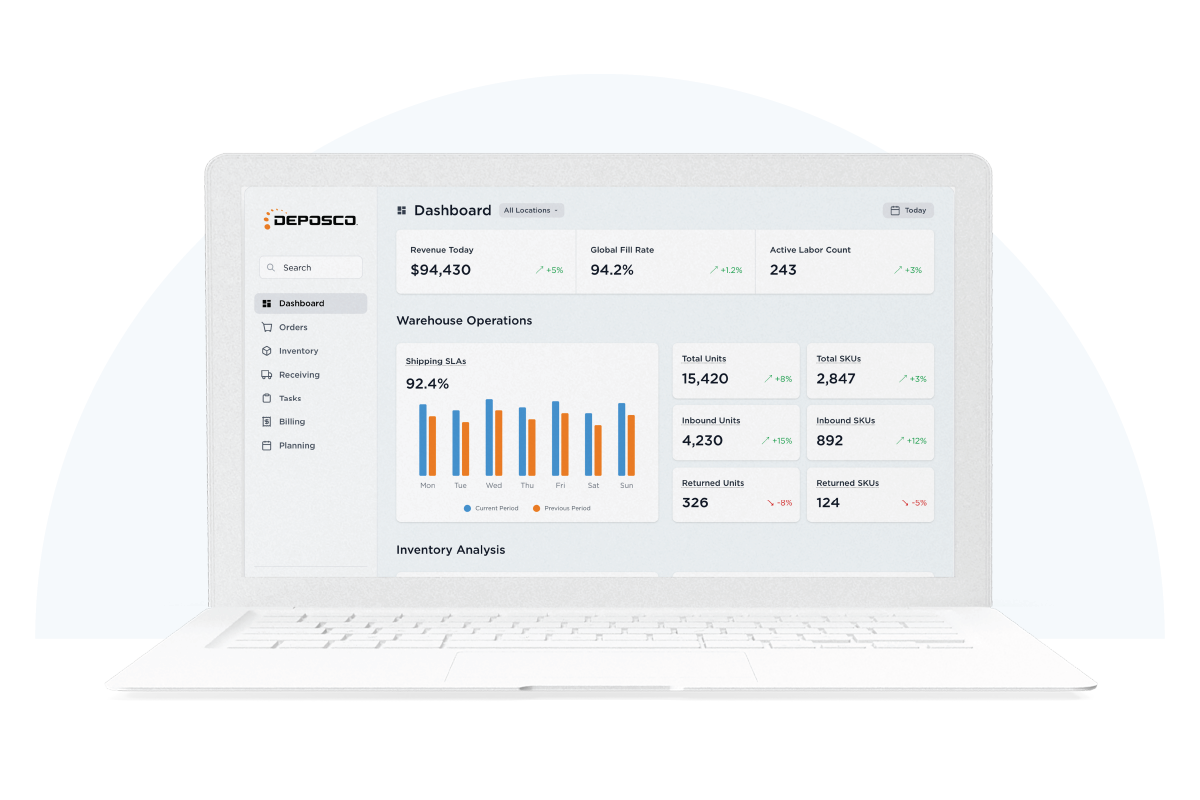
Bright Portal arrived in April 2026 as a built-in part of the Deposco platform rather than a bolt-on. The data a client sees, the warehouse work underneath it, the billing, the order management, and the planning all originate in one system. For 3PLs that compete on the relationship rather than the rate alone, that’s the difference that compounds—and the buyer Bright Portal was built for.
Key feature #1: Real client action, with an AI assistant doing the legwork
Gap: A lot of 3PL portals stop at display. Clients can look up stock and order status, but the moment they need to change something—holding a shipment, editing an order, or kicking off a return—it becomes an email to the account team. Scale that across a growing roster of clients and your best operations people turn into a help desk.
How Bright Portal addresses it: Bright Portal hands clients the controls, not just the view. Inside boundaries the 3PL sets, clients carry out their own changes, and an AI assistant answers questions and starts actions in plain language, so routine requests resolve without a ticket.
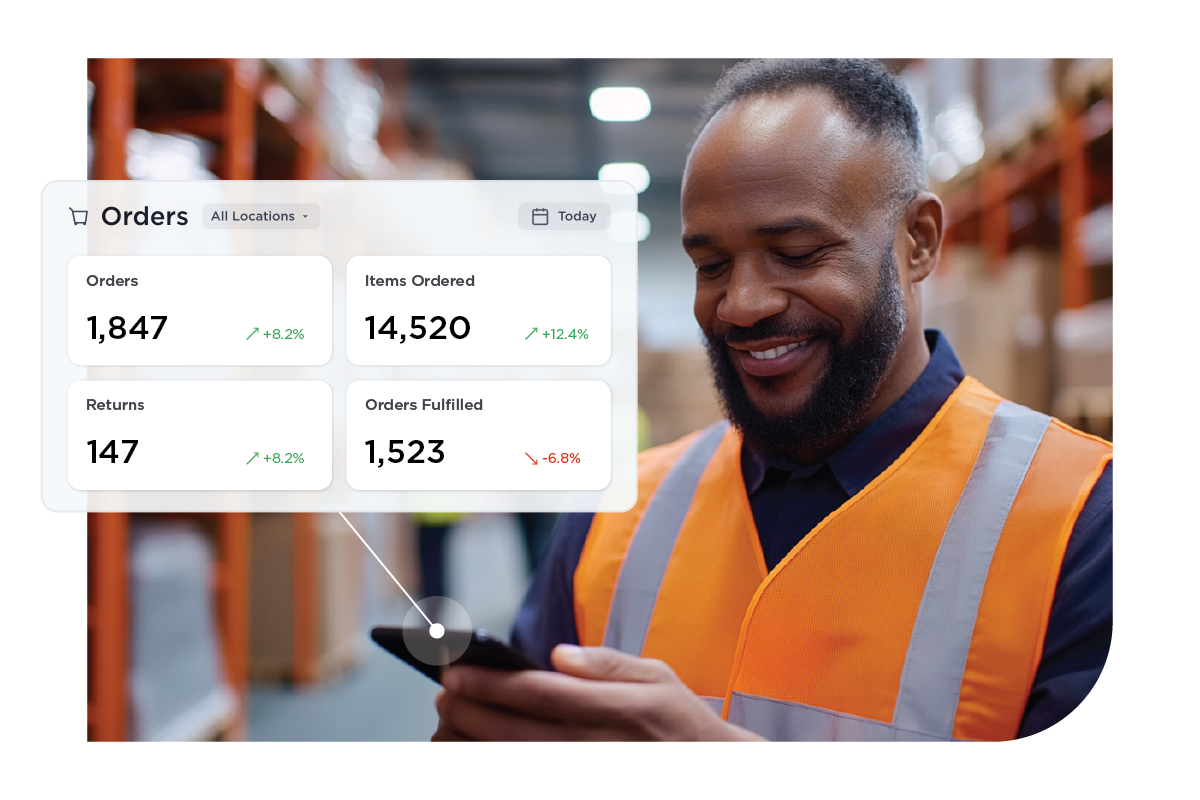
Scenario: A cosmetics brand gets a sudden returns spike after an influencer post drives a wave of impulse buys that don’t stick. Rather than firing off a string of emails, the brand’s team opens Bright Portal, sees the inbound returns building, and adjusts the disposition rules for the affected SKUs themselves; the AI assistant confirms which lots are eligible for restock versus write-off, and the change applies within the limits the 3PL pre-set. The operations team watches it unfold on the dashboard and only steps in on the edge cases.
Key feature #2: One system, not a portal wired on top of separate tools
The gap: A portal assembled from systems that don’t share a foundation shows its seams over time: data that lags reality, connectors that break after an upgrade, and client screens that quietly fall out of step with what the warehouse is actually doing. The demo looks clean; the second year doesn’t.
How Bright Portal addresses it: Bright Portal shares Deposco’s data model outright. The client’s view, the warehouse’s execution, the billing math, and the planning all reference the same records. There’s no sync to babysit and no seam for an update to break.
Scenario: A 3PL signs a new client mid-quarter with a sprawling catalog and an aggressive go-live date. Because the client’s portal view and the warehouse operations run on the same system, onboarding the catalog once makes it visible to the client, receivable in the warehouse, and billable at the right rates all at the same time—with no second build to stand up a separate client-facing portal and no gap between what the client sees and what the floor is doing on day one.
Key feature #3: Demand planning the client helps build
Gap: Most portals only look backward. They summarize what already happened and leave the forward-looking work to spreadsheets and email, which keeps the quarterly review tactical and keeps the 3PL boxed in as a vendor rather than a partner.
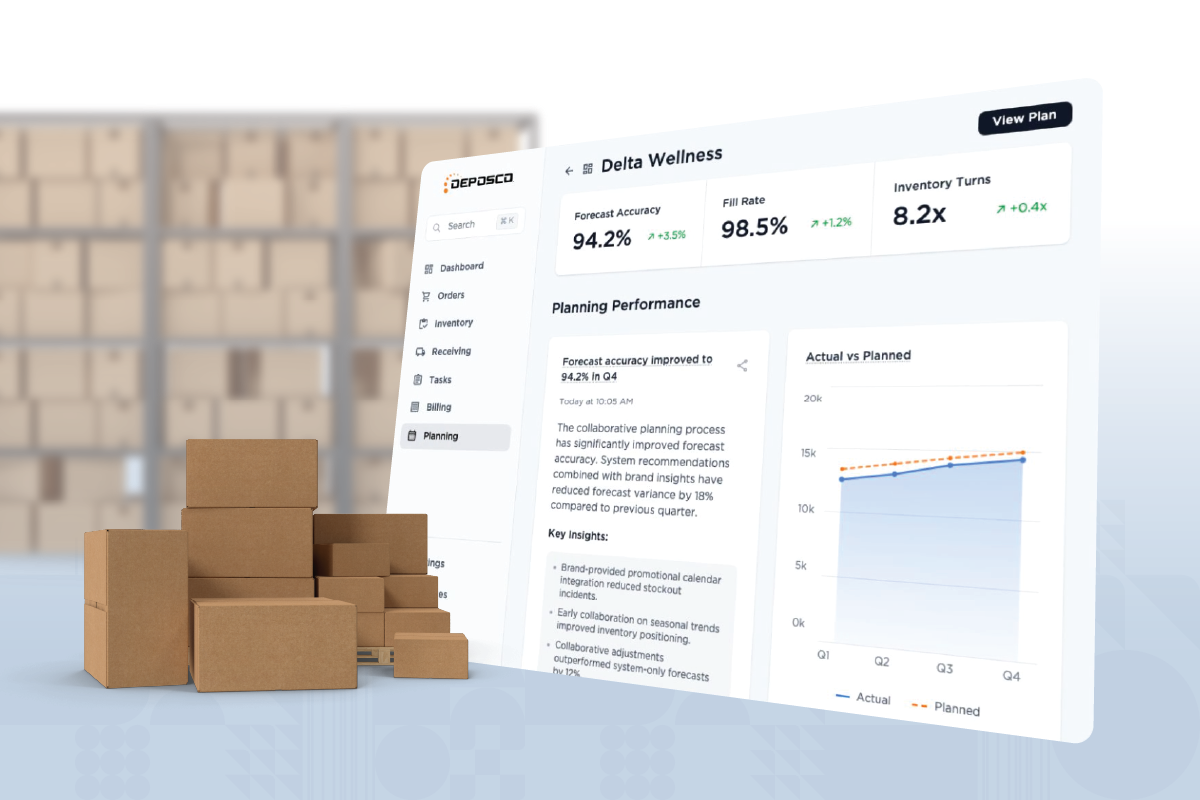
How Bright Portal addresses it: Bright Portal includes a shared planning space running on Deposco’s demand planning engine. The 3PL and client work from the same forecast, promo calendar, and target stock levels, and the 3PL can route that signal straight into capacity and labor planning. Check-ins stop being status updates and start being joint strategy.
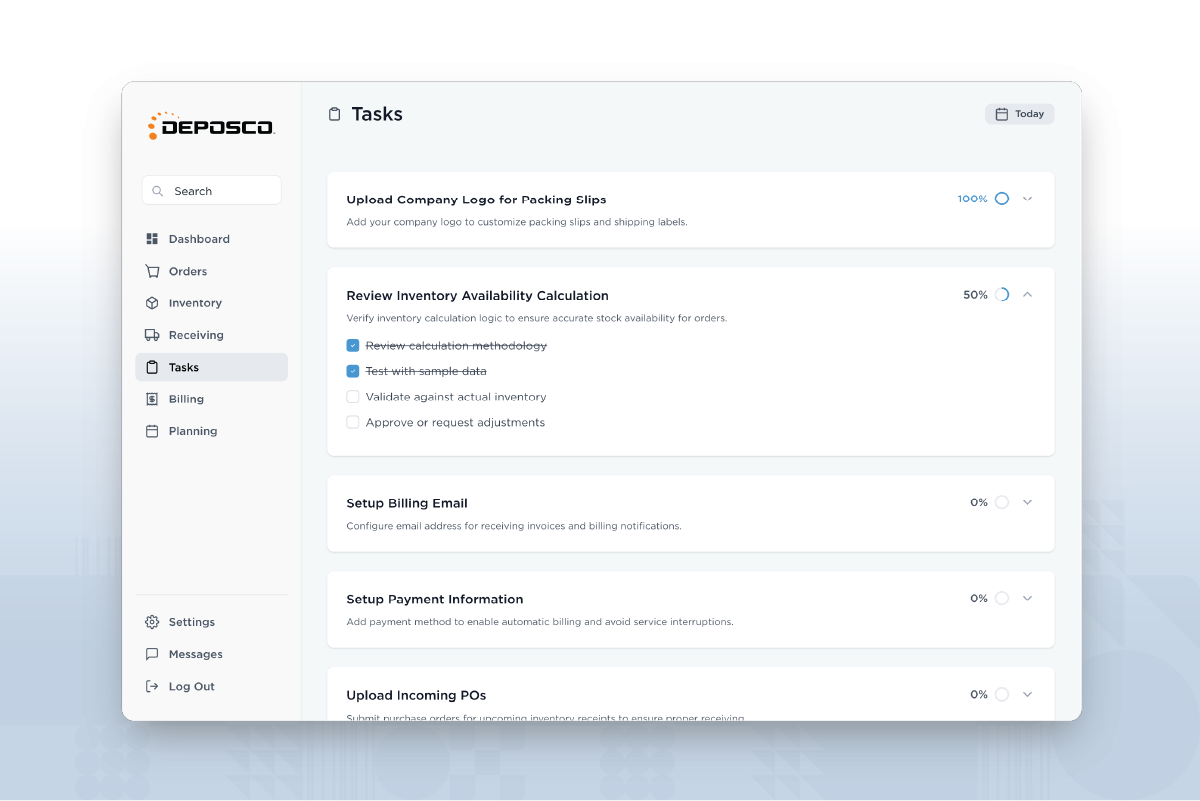
Scenario: An outdoor-gear brand and its 3PL meet as the season turns from summer to winter and the catalog mix flips almost entirely. Instead of reacting week to week, the two teams use the shared planning view to phase out warm-weather stock, stage the incoming winter range across the network, and agree on the labor the 3PL will line up for the transition. The brand leaves with a plan it co-built—and a relationship it would think twice about unwinding.
Key feature #4: Branded, review-ready dashboards with nothing to implement
Gap: Prepping for quarterly reviews quietly burns account-management time. Reports get rebuilt each cycle from disconnected sources, then reskinned per client. Portals that claim to fix this usually arrive with a multi-month rollout and ongoing IT upkeep to keep the branded views and permissions accurate.
How Bright Portal addresses it: Bright Portal’s dashboards stay live and on-brand without an export step. Service levels, shipping performance, and inventory accuracy render in the client’s own terms. The portal carries the 3PL’s logo, colors, and domain, and the 3PL’s own team manages permissions, views, and onboarding without developer time. Existing Deposco customers switch it on with no separate implementation.
Scenario: A 3PL’s growth lead walks into a renewal that’s gone competitive, with the client holding a rival’s proposal. Instead of scrambling to assemble a value-recap deck, she pulls up the client’s own branded portal live: their service-level trend, their cost-to-serve, the inventory accuracy they’ve come to rely on. The conversation reframes from “justify your rate” to “here’s what we’d optimize together next year,” with the proof already on screen.
The only 3PL client portal natively built into your WMS — actionable, white-labeled, and ready now without an implementation project.
2. Octup
Octup is an overlay that draws analytics and billing data from a 3PL’s existing WMS and ERP and presents it to clients through configurable dashboards, with natural-language search for digging into the detail.
Features & capabilities
- Configurable branded dashboards covering client order activity and performance
- Natural-language search across operational data, backed by AI-assisted query
- Automated charge capture with line-item billing detail
- Overlay deployment layered over a 3PL’s existing core systems
What to watch
Octup’s overlay model is the trade-off to weigh. Clients view their data through the overlay, but acting on it still routes back to the underlying WMS—a lighter install up front in exchange for a workflow seam that tends to become more visible as account volume grows.
3. Made4Net Synapse Anywhere
Made4Net’s Synapse Anywhere portal runs next to the company’s warehouse management system, giving clients web access to inventory and shipment data linked to billing events.
Features & capabilities
- Web-based client visibility into stock positions and shipment status
- Billing automation tied to warehouse transaction events
- Light assembly, labeling, and value-added service handling
- Integration with the wider Made4Net WMS platform
What to watch
Made4Net’s primary investment is the WMS, with the portal as a companion capability. Where the deciding factor is the client-facing experience rather than the warehouse engine, the portal feature set may feel less developed than at vendors investing specifically in client experience.
4. Extensiv Hub
Extensiv Hub provides client portal access and operational oversight for 3PLs running multiple warehouse sites, connecting order data to billing and invoicing.
Features & capabilities
- Cross-site visibility into inventory and order detail for client accounts
- Activity-based billing automation spanning warehouse sites
- A central dashboard for monitoring operations network-wide
- Tooling for invoicing and charge reconciliation
What to watch
Extensiv Hub covers the multi-site billing and visibility use case well. Before committing, pressure-test the current client-facing portal feature set against the specific expectations your accounts bring—particularly around self-service and planning—by requesting a live demonstration with your own workflow scenarios.
Why Deposco Bright Portal Stands Out Among Logiwa 4PL Client Portal Alternatives
These options aren’t built for the same job. Octup keeps the install light as an overlay. Made4Net’s portal accompanies its WMS. Extensiv Hub anchors on multi-site billing automation. Each answers a particular need well.
For 3PLs that want the client experience to be the reason accounts renew—including those who picked Logiwa for its workflow tools and now want clients to do more than look—Bright Portal brings four things together in one platform:
- Real self-service with an AI assistant, so clients execute their own changes inside 3PL-set limits instead of queuing behind your team
- One integrated system where the client view, warehouse operations, billing, and planning are the same records—not a portal layered over separate tools
- Shared demand planning that turns quarterly reviews into forward-looking strategy and raises the cost of leaving
- On-brand dashboards with nothing to implement for existing Deposco customers, configured by the 3PL’s own team without IT
If Logiwa’s workflow configuration got you part of the way but your clients now expect to act inside the portal, Bright Portal is built for that next step.