Shopify’s Stocky app shuts down on August 31, 2026. After that date, the app stops functioning, API connections break, and unmigrated data becomes inaccessible. The wind-down has been underway for a while: inventory transfers and min/max forecasting were removed in July 2025, and Stocky was delisted from the Shopify App Store on February 2, 2026.
Shopify merchants usually relied on Stocky because they were tired of dealing with the same operational gaps. Purchase orders lived in spreadsheets and email threads instead of a system connected to the store. Stocktakes and cycle counts happened on paper, then got keyed into Shopify after the fact. Reordering ran on gut feel because there was no forecasting tied to actual sales velocity. And receiving errors quietly corrupted inventory accuracy across every channel that pulled from the same stock pool.
Stocky covered those workflows. Now its replacement needs to, on day one, and with room for what comes next. A single-store DTC brand and a 40-location omnichannel retailer should not pick the same tool.
In this post, you’ll find 7 Stocky alternatives to help you choose the best inventory management replacement for your operation:
- Deposco ← replaces Stocky inside Shopify POS, backed by a full fulfillment platform
- Prediko
- Inventory Planner by Sage
- SKUSavvy
- Monocle
- EasyScan
- Shopify’s native inventory tools
If you’re looking for a Stocky replacement that runs natively inside Shopify POS, get Deposco on the Shopify App Store →
1. Deposco
Deposco is the one option on this list that replaces Stocky inside Shopify POS while connecting those workflows to a full fulfillment platform behind the scenes. It’s built for brands and retailers running (or planning) true omnichannel: multiple locations, BOPIS, ship-from-store. Stocky’s core workflows are covered from day one; the platform behind them is what Stocky never had.
Key feature #1: Stocky’s workflows, native in Shopify POS
Pain point: Most Stocky replacements are standalone apps, which means store associates juggle a second interface, or a second device, just to run a cycle count or receive a purchase order.
Solution: The Deposco extension is built natively into the Shopify POS interface. Cycle counting, purchase orders, and receiving run in the screen associates already know, with no app switching.

Scenario: Imagine you’re a store manager opening the quarter with a wall-to-wall count across three locations. Instead of printing count sheets and re-keying totals into a separate app, each associate scans through their zone directly in POS. Counts post to inventory in real time, and you reconcile variances before the store opens.
Key feature #2: Real-time inventory visibility across every location
Pain point: Most inventory apps only show stock by location on a delay, which means associates sell against numbers that are already wrong, then walk customers when the shelf looks empty.
Solution: Deposco provides real-time Available-to-Promise (ATP) inventory visibility, synced with Shopify across all surfaces. Associates see accurate stock across every store, warehouse, and in-transit shipment.
Scenario: Imagine you’re a retail associate and a customer wants a size that just sold out on your floor. Instead of losing the sale, you check ATP in POS, see four units at a store across town and stock in the warehouse, and offer same-week delivery. The sale closes at the counter.
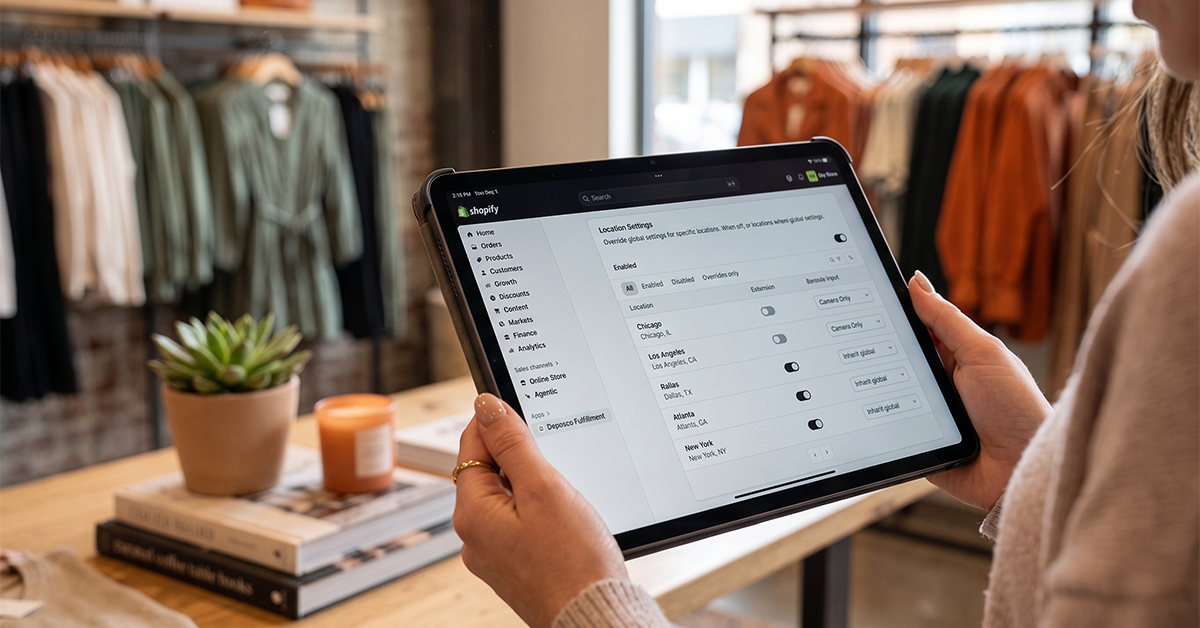
Key feature #3: Order routing and omnichannel fulfillment from POS
Pain point: Most Stocky-class tools stop at purchasing, which means orders still route on static rules while stores sit on sellable inventory that never works as fulfillment capacity.
Solution: Deposco routes each order to the smartest fulfillment point automatically, and runs Buy Online, Pickup In Store (BOPIS) and Ship-from-Store natively in POS. Every store becomes a fulfillment asset.
Scenario: Imagine you’re an ecommerce operations lead during a promotion surge. Orders that would have queued at your one warehouse route automatically to the stores closest to each customer with stock on hand. Pickup orders land on the POS screen at the right location, and ship-from-store absorbs the overflow without a single manual reassignment.

Key feature #4: A platform to grow into, not out of
Pain point: Most point apps replace one Stocky workflow well, which means growing merchants end up stacking three or four disconnected tools as locations, channels, and SKUs multiply.
Solution: Behind the POS extension sits the full Deposco platform: demand forecasting through Bright Forecast, warehouse management, order management, and Supply Chain Intelligence. One system carries you from a handful of stores to enterprise volumes.

Scenario: Imagine you’re the operations lead at a scaling DTC brand. Plant Therapy ran this play with Deposco: 3x productivity, 7x order volume, and fulfillment in under 24 hours. Hourglass Cosmetics went live in under 90 days from signing and hit 99.95% order accuracy. That’s the ceiling difference between a point app and a platform.
Plant Therapy grew order volume 7x. Hourglass went live in under 90 days and hit 99.95% accuracy. Get the extension that becomes a platform.
2. Prediko
Prediko is an inventory planning app for Shopify positioned toward DTC brands, with demand forecasting and replenishment as its core focus. It is a planning tool rather than an operations platform: it does not run in-store POS workflows or route orders.
Features & capabilities
- Demand forecasting: Generates sales-based forecasts to guide replenishment timing, with AI models trained on the brand’s Shopify sales data.
- Reorder alerts: Flags SKUs approaching stockout based on velocity and lead times.
- Purchase order generation: Creates POs automatically from forecast and reorder recommendations.
- Raw-material planning: Supports component-level planning for brands that manufacture their own products.
3. Inventory Planner by Sage
Inventory Planner is one of the longest-standing inventory planning tools in the Shopify ecosystem, acquired by Sage as part of its Brightpearl portfolio. It centers on forecasting and buying workflows for merchants with dedicated planning functions.
Features & capabilities
- Demand forecasting: Forecasts by SKU using sales history, seasonality, and trend inputs.
- Open-to-buy planning: Supports budget-based purchasing plans across categories and time periods.
- Replenishment recommendations: Calculates reorder quantities and timing against target stock levels.
- Reporting: Provides inventory performance reporting, including overstock and lost-revenue views.
4. SKUSavvy
SKUSavvy is a mobile-first warehouse management system for Shopify merchants whose operations center on their own warehouse rather than a retail floor. It covers Stocky’s purchasing features and extends into warehouse execution.
Features & capabilities
- Visual bin management: Organizes inventory by bin location with a visual warehouse layout.
- Purchase orders: Manages PO creation, tracking, and receiving against expected quantities.
- Pick and pack workflows: Directs picking paths and packing steps from mobile devices.
- Shipping: Generates labels and fulfills Shopify orders from within the same system.
5. Monocle
Monocle is a purchasing-focused inventory tool built around purchase orders and forecasting, with CSV import designed for merchants moving off Stocky. It deliberately stays narrow in scope: purchasing and forecasting, without warehouse or POS execution.
Features & capabilities
- Purchase order management: Creates and tracks POs with supplier-level detail.
- Machine-learning forecasting: Projects demand from sales history to time reorders.
- Bulk operations: Supports bulk edits across POs and SKUs.
- CSV migration: Imports Stocky data exports to preserve purchasing history.
6. EasyScan
EasyScan approaches inventory from the barcode up, built for merchants whose Stocky usage revolved around physical counting and receiving accuracy. Purchase orders are available on its higher-tier plan.
Features & capabilities
- Barcode scanning: Runs counting, receiving, and order fulfillment from barcode scans.
- Stocktakes: Supports scan-based full counts and cycle counts with variance reporting.
- Order verification: Scans items during fulfillment to catch mis-picks before shipping.
- Purchase orders: Manages POs and scan-based receiving on the higher tier.
7. Shopify’s native inventory tools
Shopify has been folding basic purchasing and inventory capabilities into the core Admin, included with existing Shopify plans. Native tools cover simple operations, with clear limits: no advanced forecasting, no order routing, and limited multi-location intelligence.
Features & capabilities
- Inventory tracking: Tracks stock levels by location within the Shopify Admin.
- Basic transfers: Moves inventory between locations with manual initiation.
- Inventory adjustments: Records manual adjustments with reason codes.
- Reporting: Provides standard inventory reports through Shopify analytics.
Choosing your Stocky replacement
Each option here covers part of what Stocky did. Deposco stands out because it covers Stocky’s workflows where your team already works — inside Shopify POS — and connects them to real-time inventory visibility, order routing, and a fulfillment platform that scales as locations, channels, and SKUs multiply. Plant Therapy grew order volume 7x on that foundation. A point app replaces Stocky; a platform replaces the ceiling Stocky put on your operation.
Replace Stocky inside Shopify POS with cycle counts, purchase orders, real-time ATP inventory, and order routing — all in one extension backed by a fulfillment platform built for omnichannel growth.